
My Sister Is Marrying a Man Just Like Our Abusive Father—Now She Says I’m Selfish for Refusing to Accept Him. AITA?
An older sister is having a hard time accepting her younger sister’s engagement. The two sisters had a difficult childhood. Their family struggled with money, sometimes had no stable home, and often did not have enough food. The older sister also says their father treated the family poorly. As an adult, she started going to therapy to understand how those experiences affected her life. With professional counseling and mental health support, she learned how to set healthy boundaries. So when her younger sister introduced her new boyfriend, who works in the Navy, she quickly became uncomfortable. His attitude and behavior reminded her of their father.
The younger sister had been dating her boyfriend for about a year before they started talking about marriage. The older sister was worried because she believed he did not always treat her sister with respect. She also had concerns about how he handled money and disagreements. Her worries grew when her younger sister began calling her in tears after arguments with him. Sometimes, she talked about ending the relationship but later decided to stay. The older sister tried to listen and offer relationship advice, but the same conversations kept happening. After a while, she felt that these talks were affecting her own emotional well-being.
The older sister finally told her sibling that she could not keep having the same conversations about leaving the relationship. She also admitted that she did not like or respect her sister’s fiancé because of the way he treated her. This caused problems between them, and the younger sister canceled a birthday trip they had planned together. Their relationship had already been difficult for some time. The younger sister previously felt that her sibling was not supportive because she did not want to spend time with her boyfriend. The older sister had tried to be friendly at first but later chose to keep her distance. During one argument, the younger sister even called her selfish.
The disagreement became more serious when the younger sister asked the older sister’s husband why his wife disliked her fiancé. He explained that the man’s behavior reminded her of their father and brought back difficult childhood memories. The younger sister still felt that her sibling should make an exception for her. Now the older sister is wondering whether she is being unfair. She wants her sister to be happy, but she also wants to protect her own mental health. The situation raises questions about family relationships, personal boundaries, and emotional support. Should she put aside her feelings to support the wedding, or is it reasonable to keep her distance?







Woman Refuses to Accept Her Sister’s Fiancé Because He Reminds Her of Their Father
Family relationships can be complicated, especially when someone you love is planning to marry a person you don’t trust.
One woman shared a difficult situation involving her younger sister and her sister’s fiancé.
The two sisters had a hard childhood. Their family struggled with money, and they experienced periods of homelessness and food insecurity.
According to the older sister, their father also treated them in ways that caused emotional and financial harm.
As an adult, the older sister spent years in therapy. She worked on understanding her childhood and learning how to set healthy boundaries.
But now she sees some of the same troubling behavior in her younger sister’s fiancé.
Her younger sister has called her many times, crying about problems in the relationship and talking about leaving him.
Yet she continues the relationship and plans to marry him.
The older sister has reached a point where she no longer wants to spend time with the fiancé or keep having the same upsetting conversations.
Her younger sister feels hurt and believes family should support each other no matter what.
So, is the older sister wrong for refusing to accept her future brother-in-law?
Why Their Childhood Still Matters
The sisters did not have an easy childhood.
According to the Reddit story, their family faced serious financial problems.
There were times when they did not have a stable home or enough food.
The older sister also described their father as emotionally and financially harmful.
Growing up in that kind of environment can affect how someone feels about relationships later in life.
Children need safety, support, and stability.
When those things are missing, it can become harder to trust people or feel comfortable during disagreements.
Research on difficult childhood experiences has found links between early family problems and health or relationship challenges later in life.
However, everyone responds differently.
Some people become very careful about whom they trust.
Others may find it difficult to recognize unhealthy behavior because certain patterns feel familiar.
The older sister says therapy and mental health support helped her understand what happened during her childhood.
She also learned that she could love her family without accepting behavior that made her uncomfortable.
That is an important part of her story.
Why the Sisters See the Situation Differently
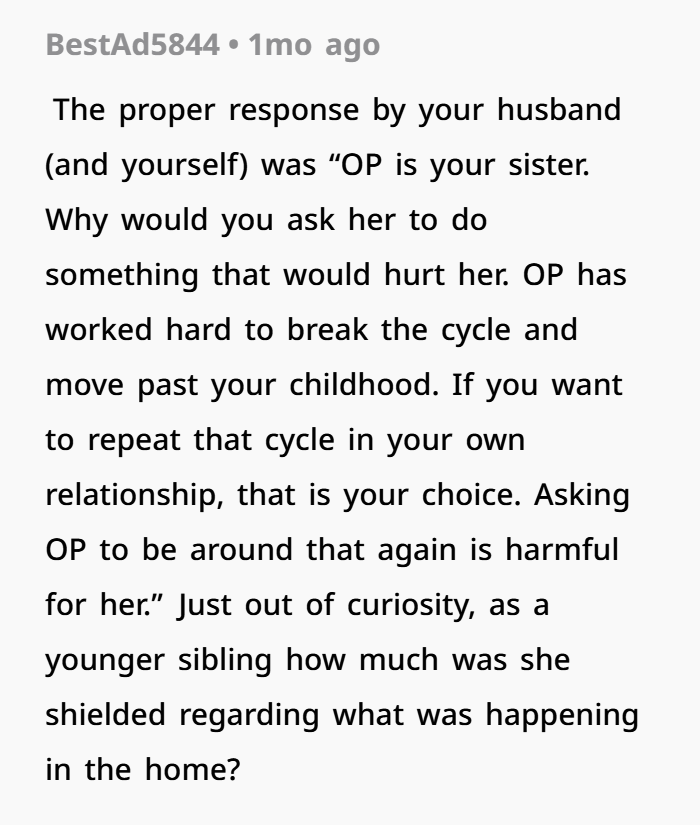
Even though the sisters grew up in the same family, they may not remember or understand their childhood in exactly the same way.
That is not unusual.
Two children can live in the same home and still have different experiences.
They may have different relationships with their parents.
They may also develop different ways of handling stress.
The older sister has spent years working through her past in therapy.
Her younger sister apparently has not taken the same approach.
That does not automatically mean one sister understands everything correctly and the other does not.
It simply means they may look at relationships differently.
The older sister sees warning signs in the fiancé’s behavior.
The younger sister may see a person she loves and hopes to build a future with.
Both women have strong feelings about the situation.
And neither can force the other to see things the same way.
What Worries the Older Sister About the Fiancé?
The older sister believes her sister’s fiancé behaves in ways that remind her of their father.
She describes him as dismissive of feelings and unfair when it comes to money.
She also says her younger sister has repeatedly called her while upset about the relationship.
During those conversations, the younger sister has reportedly talked about leaving him.
That would be difficult for any concerned family member to hear.
When someone you love keeps telling you that a relationship is making them unhappy, it is natural to worry.
The older sister is especially concerned because the behavior sounds familiar to her.
But there is an important difference between noticing troubling behavior and giving someone a medical diagnosis.
The older sister may believe the fiancé has narcissistic traits.
However, a personality disorder cannot be diagnosed from a secondhand story.
What matters most is how someone treats their partner.
Healthy relationships should include respect, honest communication, and fair treatment.
When one person regularly feels ignored, pressured, or controlled, those concerns deserve attention.
Financial Problems Can Be a Warning Sign
Money is another important part of this story.
The older sister says the fiancé has shown signs of financial manipulation.
The Reddit account does not explain exactly what he has done, so it would be unfair to assume specific actions.
Still, financial control can be a serious issue in relationships.
For example, it may be concerning if one partner tries to control all the money, prevents the other person from working, or makes important financial decisions without agreement.
A healthy relationship should allow both people to understand their finances and take part in decisions that affect them.
This is why personal financial planning, joint budgeting, and financial independence are important topics for couples preparing for marriage.
Before getting married, partners should be able to discuss income, savings, debt, and shared expenses openly.
They should also feel comfortable asking questions about money.
If someone feels pressured or afraid to discuss finances, that may be a reason to seek support.
In this story, the older sister’s concerns about money add to her worries about the engagement.
But without more details, readers cannot know exactly what is happening between the couple.
Why the Older Sister Doesn’t Want to Hear the Same Problems Again
One of the hardest parts of the story is the younger sister’s repeated phone calls.
According to the older sister, her sibling often calls while crying about her fiancé.
Sometimes, she says she wants to leave the relationship.
But later, she decides to stay.
After hearing this many times, the older sister has become emotionally tired.
She does not want to keep discussing the same problems when nothing seems to change.
That feeling is understandable.
Listening to someone you love describe a painful situation can be exhausting.
It can be even harder when those conversations remind you of your own childhood.
The older sister has worked hard to protect her emotional well-being.
She does not want to return to the same feelings she experienced growing up.
Setting personal boundaries is an important part of mental health care.
But the way those boundaries are explained matters.
There is a difference between saying you cannot have a long, upsetting conversation every day and telling someone they cannot come to you unless they leave their partner.
The first protects your time and emotional energy.
The second could make someone feel they have nowhere to turn.
Why Leaving a Difficult Relationship Isn’t Always Easy
From the outside, it may seem simple.
If a relationship makes someone unhappy, why don’t they leave?
But real relationships are often more complicated.
People may stay because they love their partner.
They may hope things will improve.
They may worry about money, housing, family expectations, or what will happen after a breakup.
Some may feel embarrassed about changing their plans, especially when a wedding is already being discussed.
And if a relationship involves controlling behavior, leaving can require extra planning and support.
That is why telling someone to leave immediately may not always help.
A person may need time to understand the situation and decide what to do.
They may also need relationship counseling, financial guidance, or practical support.
The younger sister’s repeated calls could mean she is confused about what she wants.
They could also mean she is struggling with problems that are difficult to solve.
The story does not give enough information to know for certain.
But her older sister can still care about her without agreeing to every conversation.
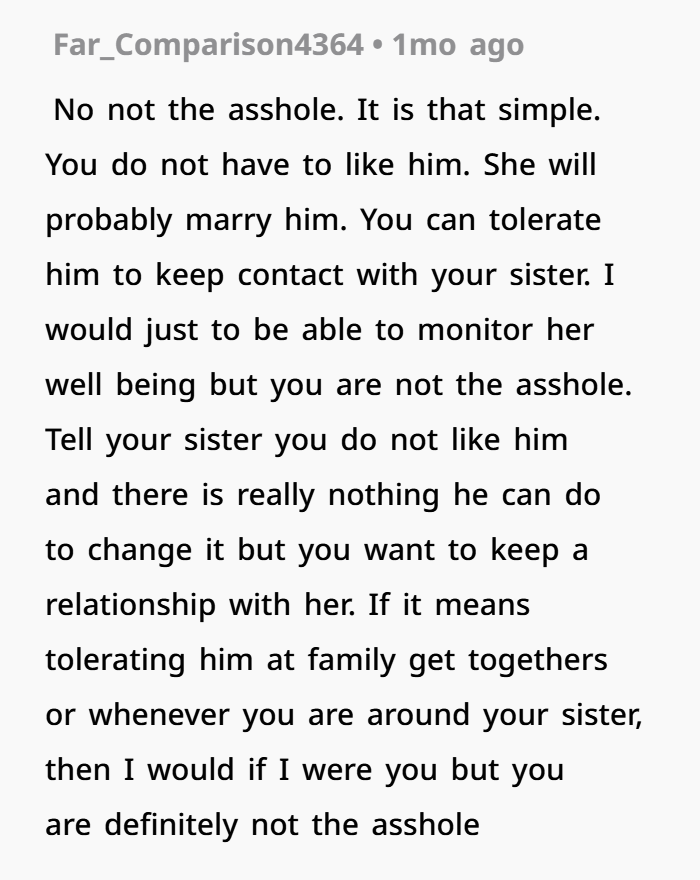
Can You Love Your Sister Without Liking Her Fiancé?
Yes.
This may be the most important lesson in the story.
The older sister does not have to become close friends with her future brother-in-law.
She does not have to spend time alone with him.
She also does not have to pretend that she approves of the relationship.
Her younger sister has the right to choose whom she marries.
But the older sister has the right to decide whom she feels comfortable spending time with.
Both things can be true.
Family loyalty does not mean giving up every personal boundary.
At the same time, disagreeing with someone’s relationship does not mean you have to stop loving them.
The older sister can say that she is uncomfortable around the fiancé while still making it clear that she cares about her younger sister.
That may help keep their relationship strong even when they disagree.
Why the Younger Sister Wants Her Family’s Support
The younger sister reportedly asked the older sister’s husband why her sibling could not make an exception for her.
She seems to believe that being sisters should be enough reason to accept the fiancé.
From her point of view, she may feel rejected.
She is planning a wedding and probably wants her family to be happy for her.
Instead, someone close to her is refusing to build a relationship with the man she plans to marry.
That could be painful.
But support and approval are not exactly the same thing.
The older sister can support her sibling as a person without approving of every decision she makes.
She can wish her happiness while still being honest about her concerns.
And she can choose not to attend certain gatherings if being around the fiancé makes her uncomfortable.
What matters is making sure the younger sister understands that the disagreement is about the relationship, not about whether she is loved.
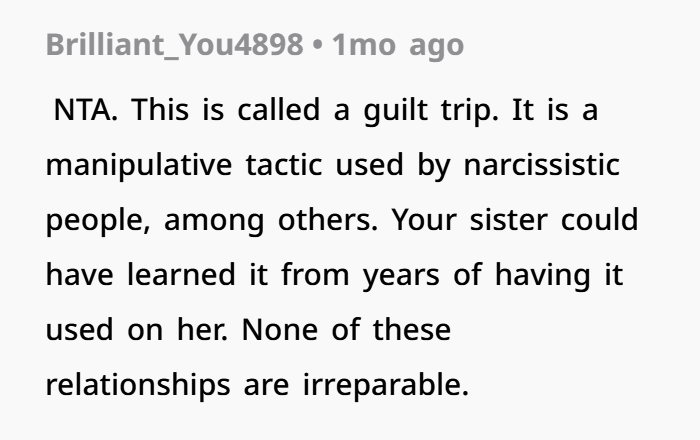
Could Pushing Her Away Make Things Worse?
There is one concern the older sister should consider.
If her younger sister feels judged every time she talks about her relationship, she may stop reaching out.
That could create distance between them.
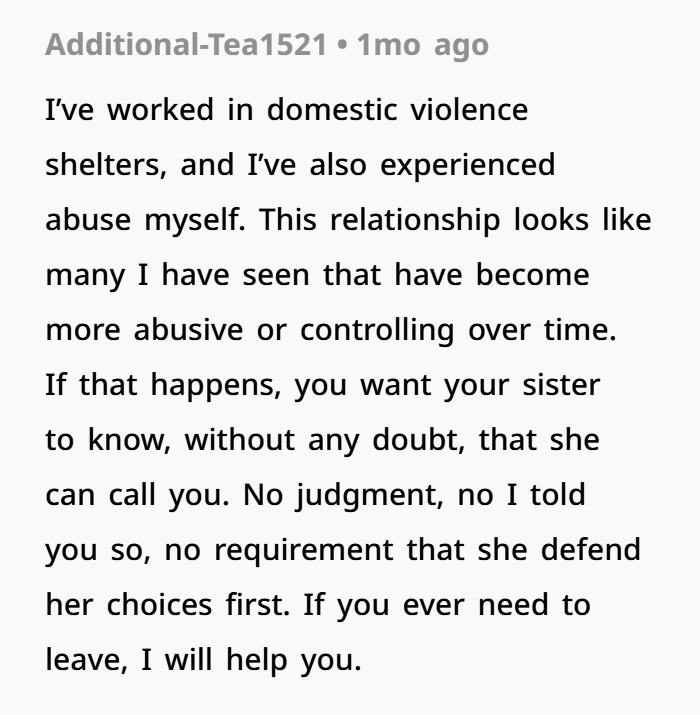
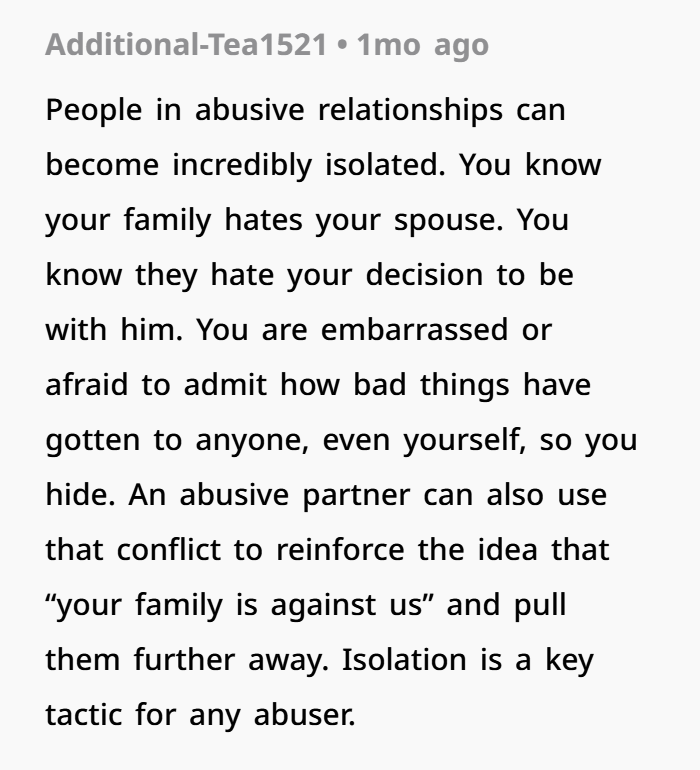
If the fiancé really is controlling, losing contact with a trusted family member could make the situation harder.
People dealing with unhealthy relationships often benefit from having supportive friends and relatives.
That does not mean the older sister has to listen to hours of complaints every day.
She can set limits.
For example, she might explain that repeated conversations about the fiancé are affecting her mental health.
She could offer to talk at a time when she feels emotionally ready.
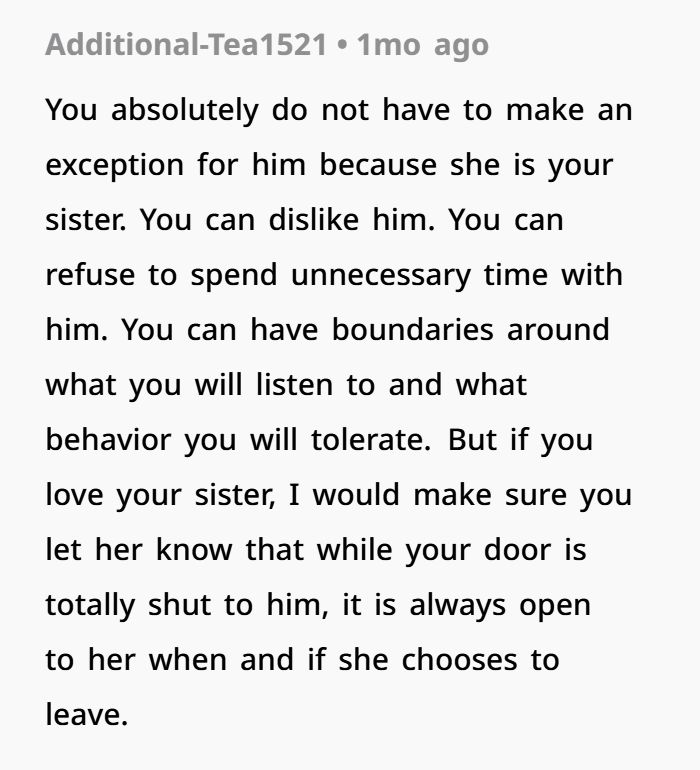
She could also make it clear that her sister can still contact her if she needs urgent help or a safe place to go.
This approach protects the older sister’s boundaries without completely closing the door.
You can care about someone and still have limits on what you can handle.
How Therapy Can Help With Family Boundaries
The older sister says therapy helped her understand the unhealthy patterns she experienced while growing up.
That kind of support can be valuable.
Therapy may help people recognize what makes them uncomfortable, communicate their needs, and respond to difficult situations more calmly.
It can also help them understand that they are not responsible for solving every family problem.
However, going to therapy does not mean someone will always be right about another person’s intentions.
Past experiences can make certain behavior easier to notice.
They can also make some situations feel more upsetting.
That is why it helps to focus on specific actions rather than labels.
Instead of arguing about whether the fiancé is a narcissist, the sisters could talk about what he actually says or does.
For example, does he respect the younger sister’s choices?
Can she make her own financial decisions?
Does she feel comfortable disagreeing with him?
These questions are more useful than arguing over a diagnosis.
If the younger sister wants support, individual counseling or couples counseling may be options to consider, depending on the relationship’s safety. If there is fear or controlling behavior, confidential individual support is generally a safer first step than joint counseling.
What Should the Older Sister Do Now?
The older sister does not need to change her opinion of the fiancé just to keep everyone happy.
She can continue limiting her contact with him.
She can also decide which family events she feels comfortable attending.
But it may help to have one calm conversation with her younger sister.
She could explain that her concerns come from love, not from a desire to control her.
She could also say that repeated conversations about the relationship have become emotionally difficult.
Most importantly, she can remind her sister that she still cares about her.
A message like this may help:
“I love you, and I want you to be happy. I’m worried about some of the things you’ve told me, and being around him is difficult for me. I can’t keep having the same upsetting conversations, but I still care about you. If you ever need help or want to talk about a serious concern, I want you to know you can reach out.”
That would allow the older sister to be honest without making her younger sister feel completely alone.
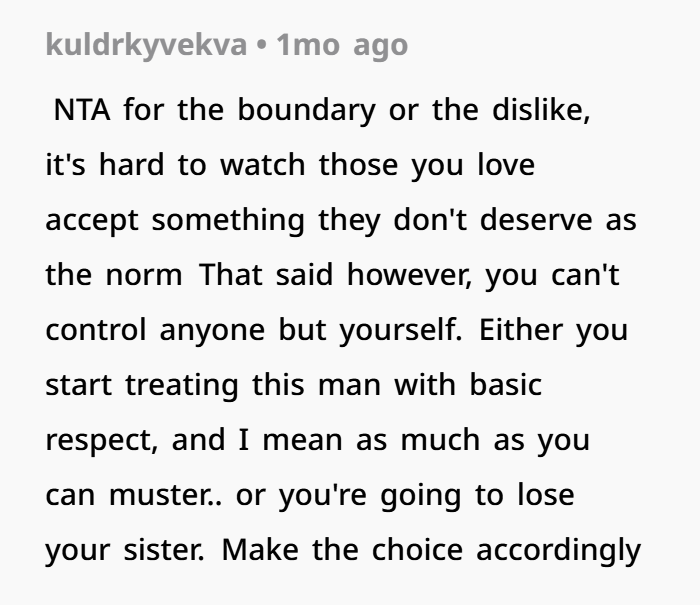
Final Verdict: NTA — But Don’t Shut Your Sister Out
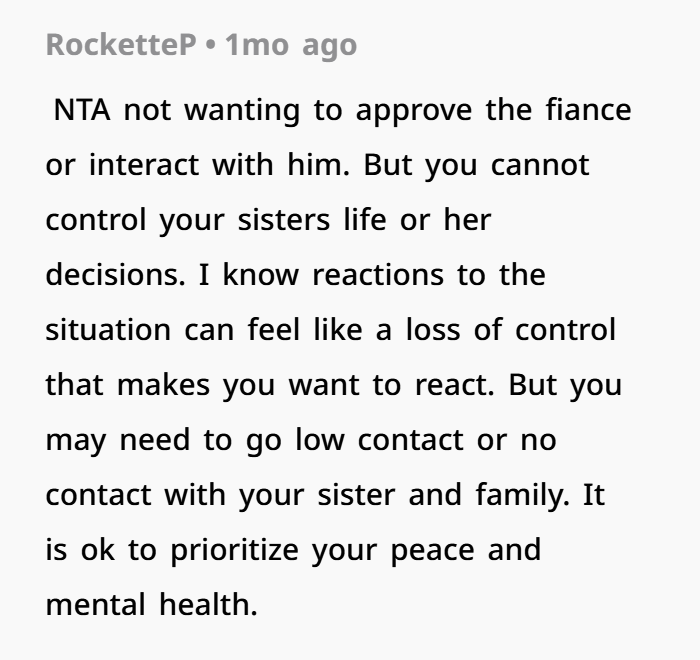
Based on the Reddit story, the older sister is NTA (Not the Asshole) for refusing to build a close relationship with her sister’s fiancé.
She has concerns about how he treats her younger sister.
She also feels that his behavior reminds her of painful experiences from childhood.
She should not have to ignore those feelings simply because her sister is getting married.
She has every right to protect her mental health and decide whom she spends time with.
However, there is an important difference between keeping distance from the fiancé and cutting off support for her sister.
The younger sister may be dealing with a difficult relationship.
If that is the case, having someone she trusts could be very important.
The older sister does not need to approve of the engagement.
She does not need to attend every family gathering or pretend that everything is fine.
But keeping communication open could help protect the bond between them.
In the end, both sisters have choices to make.
The younger sister can choose her partner.
The older sister can choose her boundaries.
Neither should be forced to agree with the other.
The best outcome would be for them to respect those differences while remembering that their relationship as sisters still matters.
What would you do?
If your sibling was planning to marry someone who reminded you of a difficult parent, would you keep your distance from that person or try to accept the relationship to stay close to your sibling?
Comments You Can’t Miss