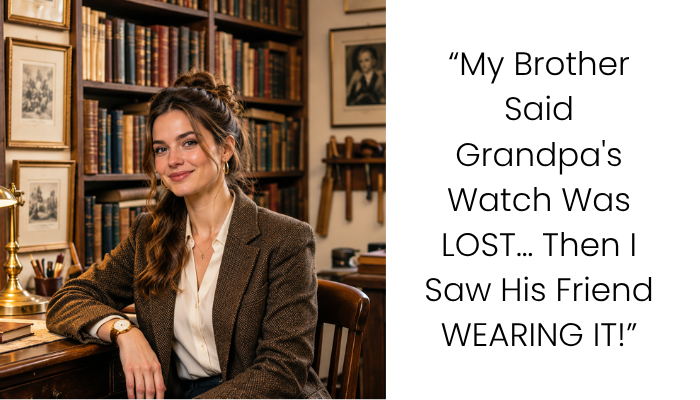
My Brother Lied About Losing Grandpa’s Watch—Then I Caught His Friend Wearing It and Exposed the Truth
A 30-year-old man shared a family disagreement involving his late grandfather’s watch. His grandfather passed away four years ago and left behind several personal belongings for the family. His younger brother, Ethan, received a wristwatch that their grandfather had worn almost every day for many years. The watch was not very expensive, but it had great sentimental value. It appeared in many family photos and reminded everyone of their grandfather. Their father had suggested giving the watch to Ethan because they had been very close. Earlier that year, Ethan told the family he had lost the watch while traveling. Everyone was sad, especially their father, but they accepted that accidents happen.
The truth came out when the older brother met Ethan’s longtime friend, Mark. During their conversation, he noticed Mark wearing a watch that looked just like their grandfather’s. When he asked about it, Mark explained that Ethan had given it to him as a thank-you gift the previous year. Mark had helped Ethan through a difficult time, and Ethan wanted to show his appreciation. The older brother asked to see the watch and found their grandfather’s initials engraved on the back. He realized it was the same family heirloom that Ethan claimed to have lost. When he spoke to Ethan privately, his brother admitted that he had given the watch away and made up the story about losing it.
A few days later, the family was having dinner when their mother mentioned the missing watch. Ethan continued saying that he wished he knew where it was. The older brother became upset and told everyone the truth. He explained that Ethan had given the watch to Mark instead of losing it. Their father was very angry, and their mother became emotional. Ethan was upset with his brother for sharing something he believed was private. He said the watch was his personal property and that he had the right to give it away. He also felt that his brother had embarrassed him in front of their parents.
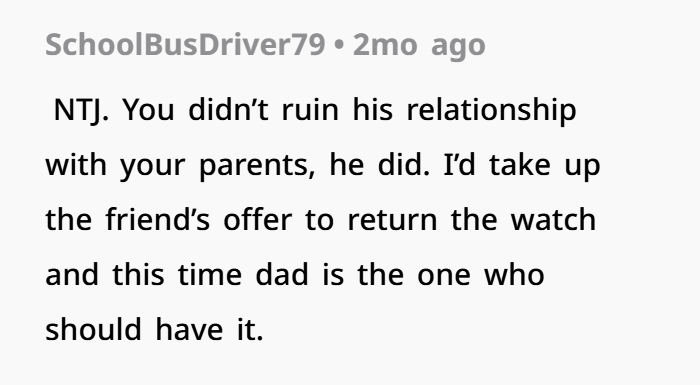
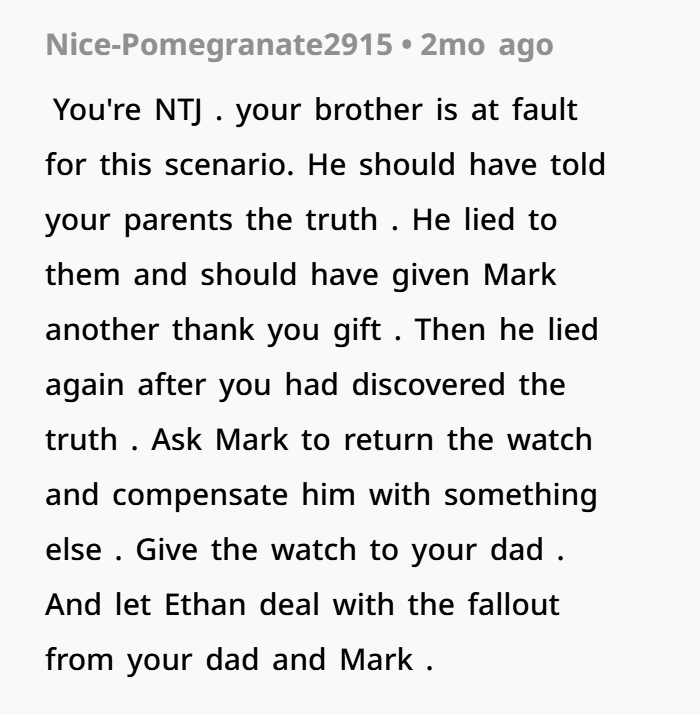
Mark later learned about the disagreement and offered to return the watch because he did not want to cause problems for the family. However, Ethan was unhappy about this because he felt the meaning of his gift had been lost. The older brother believed his parents deserved to know the truth about an important family inheritance. He understood that Ethan owned the watch, but he felt the lie had hurt the family’s trust. The situation raised questions about family heirlooms, inheritance decisions, and personal property rights. Now he wonders whether telling the truth was the right choice or whether he should have allowed Ethan to explain everything himself.




Man Reveals His Brother Gave Away Their Grandfather’s Watch After Lying About Losing It
An old watch caused a serious disagreement between two brothers.
The watch had belonged to their late grandfather. It wasn’t worth a huge amount of money, but it meant a lot to the family.
One brother, Ethan, had received the watch because he was close to his grandfather.
But instead of keeping it, Ethan gave it to his friend Mark.
That wasn’t the only problem.
When his parents asked about the watch, Ethan told them he had lost it while traveling.
His older brother later discovered that the watch wasn’t lost at all.
He saw Mark wearing it.
After learning the truth, the older brother confronted Ethan privately. Ethan admitted what happened but begged him not to tell their parents.
For a while, his brother stayed quiet.
Then Ethan repeated the story about losing the watch during a family dinner.
This time, his older brother spoke up.
Now Ethan is angry because he believes his brother had no right to reveal the truth.
But was the older brother really wrong?
The Watch Was a Special Family Memory
The watch had belonged to Ethan’s grandfather for many years.
Family members remembered him wearing it.
It also appeared in old family photographs.
After their grandfather passed away, the watch became something the family could keep to remember him.
Their father wanted Ethan to have it because Ethan had shared a close relationship with his grandfather.
That made the gift even more meaningful.
The watch was estimated to be worth only a few hundred dollars.
But its price wasn’t the reason the family cared about it.
It reminded them of someone they loved.
An expensive new watch might look nicer, but it wouldn’t carry the same memories.
That’s what makes family heirlooms different from ordinary belongings.
Sometimes an old ring, watch, necklace, or piece of furniture means more to a family than its actual market value.
For Ethan’s father, the watch was a reminder of his own dad.
Losing that connection was painful.
And learning that the watch had been given away on purpose made the situation even harder.
Did Ethan Have the Right to Give Away the Watch?
This is where the story becomes complicated.
The watch had been given to Ethan.
If he received it without any conditions, he would generally have the right to decide what to do with it.
He could keep it, wear it, sell it, or give it away.
Of course, inheritance arrangements and local property laws can sometimes affect ownership.
But the story doesn’t mention any restrictions on the gift.
So Ethan may have been allowed to give the watch to Mark.
Still, there is a difference between having the right to do something and making a thoughtful decision.
The watch was not an ordinary item.
It had belonged to their grandfather, and the family had strong feelings about it.
Ethan’s father had specifically wanted him to receive it.
That likely created an expectation that Ethan would take care of it.
Even if Ethan owned the watch, his family could still feel hurt when he gave it away.
Owning a family keepsake doesn’t mean other people’s memories stop mattering.
A conversation before giving away the watch might have prevented some of the disagreement.
Why Ethan Gave the Watch to Mark
Ethan didn’t give the watch away because he wanted to upset his family.
At least, that isn’t the reason he gave.
According to Ethan, Mark had supported him during a difficult time.
Ethan wanted to thank his friend for being there when he needed help.
Instead of buying Mark an ordinary gift, he chose something personal.
The watch had meaning to Ethan, so giving it away may have felt like a special way to show his appreciation.
That part of his decision is understandable.
Good friends can make a big difference during difficult times.
And thoughtful gifts don’t always need to be expensive.
But the watch also meant a lot to Ethan’s family.
If Ethan understood how special it was, he could have considered how his parents might feel.
He might have chosen another meaningful gift.
Or he could have explained his decision to his family before giving the watch away.
He wasn’t necessarily required to ask for permission.
But being honest from the beginning would have made things easier.
Instead, Ethan chose to keep the gift a secret.
The Real Problem Started When Ethan Lied
When Ethan’s mother asked about the watch, he said he had lost it during a trip.
That wasn’t true.
He had already given it to Mark.
His parents believed him.
His father even comforted him because he thought losing the watch had been an accident.
That detail makes the story especially upsetting.
Ethan’s father believed his son was sad about losing a treasured family item.
He didn’t know Ethan had chosen to give it away.
And Ethan allowed him to keep believing the wrong story.
This is why the disagreement became about more than the watch.
It became a question of trust.
Honesty is important in family relationships, especially when something meaningful is involved.
People can disagree about what should happen to inherited belongings.
But lying about those decisions can create even bigger problems.
Ethan may have been worried about his parents’ reaction.
Still, hiding the truth didn’t make the problem disappear.
It only made the eventual discovery more painful.
How the Older Brother Discovered the Secret
The older brother didn’t learn about the gift from Ethan.
He found out after seeing Mark wearing the watch.
That must have been surprising.
As far as the family knew, the watch had been lost while Ethan was traveling.
Yet Mark had it.
The older brother contacted Ethan privately and asked what was going on.
Ethan admitted that he had given Mark the watch.
He also asked his brother not to tell their parents.
Ethan said he was worried that the truth would cause a major family argument.
The older brother didn’t reveal the information immediately.
He kept quiet for about two weeks.
But he was uncomfortable knowing that his parents believed something that wasn’t true.
He also knew how much the watch meant to the family.
That left him with a difficult choice.
Should he protect his brother’s secret or tell their parents what had really happened?
The Truth Came Out During Family Dinner
The situation changed when Ethan repeated his story about losing the watch.
This happened during a family dinner.
The older brother had already heard the explanation before.
He also knew it wasn’t true.
This time, he decided to tell their parents what had happened.
He explained that Ethan had given the watch to Mark.
The family was upset.
Their father learned that the watch hadn’t been lost by accident.
It had been given away.
And their parents discovered that Ethan had been hiding the truth.
Ethan became angry with his older brother.
He felt his brother had shared information that should have remained private.
But the older brother believed his parents deserved to know the truth.
He didn’t want to keep listening to the same false story.
His frustration makes sense.
He had already spoken to Ethan privately.
Ethan had an opportunity to explain things himself.
Instead, he continued telling his parents that the watch was lost.
Was Family Dinner the Right Time to Tell Everyone?
The older brother had a reason to speak up.
But the timing could have been better.
A family dinner isn’t always the best place for an upsetting conversation.
When several people hear unexpected news at the same time, emotions can rise quickly.
The older brother could have given Ethan one final chance to tell their parents.
He might have explained that he was no longer comfortable keeping the secret.
Another option would have been to speak to their parents privately.
That may have made the conversation less stressful.
However, the older brother’s timing doesn’t change what Ethan did.
Ethan gave away the watch.
He told his parents it was lost.
And he continued repeating that story after his brother discovered the truth.
The older brother could have handled the situation more gently.
But that doesn’t mean he caused the original problem.
Did the Older Brother Betray Ethan’s Trust?
Ethan believes his brother betrayed him by revealing the truth.
But there’s an important detail.
Ethan didn’t originally share the information with his brother as a private secret.
His brother discovered it after seeing Mark wearing the watch.
Only when he was questioned did Ethan admit what happened.
Then he asked his brother to stay quiet.
That put the older brother in a difficult position.
He was being asked to help keep his parents from learning the truth.
Family loyalty is important, but it doesn’t mean someone must support every decision a relative makes.
The older brother had his own relationship with their parents.
He also cared about the watch and the memories connected to it.
It’s understandable that he didn’t want to continue hiding the truth.
At the same time, he could have been more careful about how he shared the information.
Both things can be true.
Mark Was Caught in the Middle
Mark seems to be the person who had the least responsibility for the disagreement.
He accepted the watch because Ethan gave it to him as a gift.
According to the story, Mark didn’t know Ethan had told his parents the watch was lost.
He also didn’t know how important it was to the family.
When Mark learned about the problem, he offered to return it.
That was a thoughtful response.
He understood that the watch carried special memories for Ethan’s family.
He didn’t want to keep something that was causing a serious disagreement.
But Ethan became even more upset.
He felt that the meaning behind his gift had been spoiled.
Still, Mark wasn’t responsible for Ethan’s decision to lie.
He had accepted a gift from a friend.
If the watch is returned, it should happen through an honest conversation rather than pressure placed on Mark.
Why Families Should Talk About Inherited Belongings
This story shows how easily family disagreements can happen over inherited property.
One person may see an old watch as something they own and can give away.
Another person may believe it should stay in the family for generations.
Both may feel strongly about their views.
That’s why estate planning and inheritance planning can be useful.
When families pass down important belongings, it helps to discuss what those items mean.
For example, parents or grandparents can explain why they want a particular person to receive a watch, ring, or other keepsake.
They can also share whether they hope the item will remain in the family.
These conversations don’t have to be complicated.
Sometimes, simply talking about expectations can prevent misunderstandings.
For larger or more complicated estates, an estate planning attorney can help explain how to record wishes in a will or other legal document.
The rules depend on local law, and not every personal wish can be enforced.
But clear planning can make it easier for families to understand what someone intended.
In Ethan’s situation, an earlier conversation about the watch might have helped everyone understand what receiving it meant.
Can the Family Rebuild Trust?
The family now has two problems to work through.
The first is what should happen to the watch.
The second is how to rebuild trust after Ethan’s lie.
Mark has already offered to return the watch.
If the people involved agree, that could help ease some of the family’s sadness.
But getting the watch back wouldn’t automatically solve everything.
Ethan’s parents may still feel hurt because he allowed them to believe something that wasn’t true.
Trust can take time to rebuild.
Ethan could start by explaining why he gave the watch to Mark.
He could also acknowledge that lying about it hurt his family.
That doesn’t mean he has to stop valuing his friendship with Mark.
He can still explain that the gift was meant to show gratitude.
But he should also recognize that his choice affected other people.
The older brother might acknowledge that telling everyone during dinner made the situation more upsetting.
And their parents may need time to understand why Ethan made his decision.
If the disagreement continues, family counseling could help them talk through their feelings.
The watch matters.
But their family relationships matter too.
Final Verdict: NTJ — The Older Brother Was Right to Tell the Truth
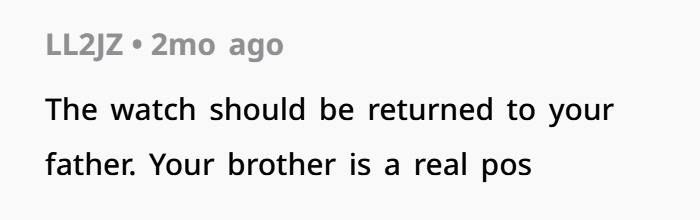
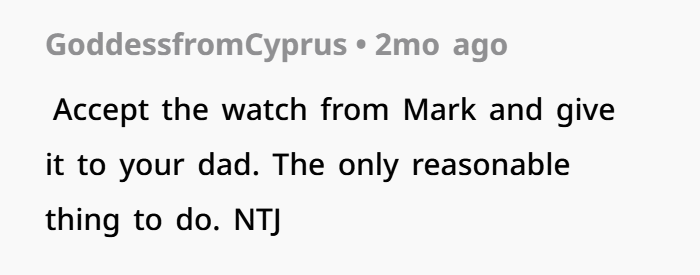
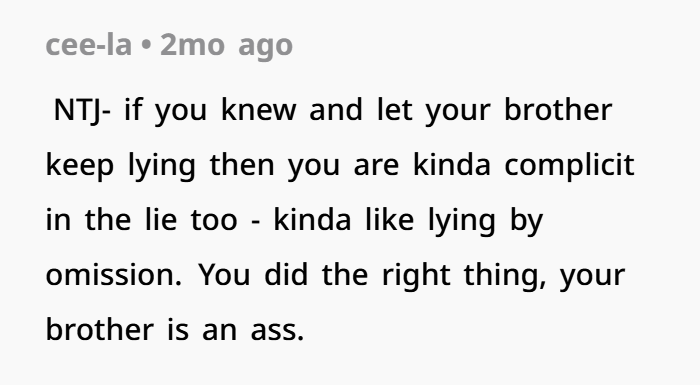
Based on the story, the older brother is NTJ (Not the Jerk) for telling his parents what really happened.
Ethan may have had the right to give away the watch.
If it was his property without restrictions, he could generally decide what to do with it.
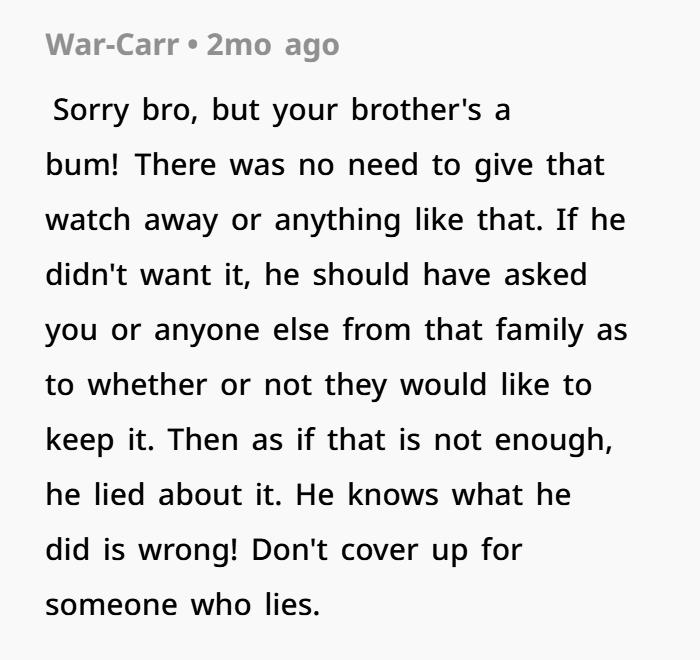
But that didn’t mean he could expect his family to accept a false story.
Ethan told his parents the watch was lost.
He allowed his father to comfort him about an accident that hadn’t happened.
And even after his older brother discovered the truth, Ethan continued repeating the lie.
The older brother wasn’t required to help keep that secret.
He could have chosen a better time to tell their parents.
But he wasn’t wrong for wanting them to know what had happened.
Mark also deserves understanding.
He accepted the watch without knowing about the family disagreement and offered to return it when he learned the truth.
In the end, this wasn’t only about an old watch.
It was about family memories, personal choices, and honesty.
Ethan had a meaningful reason for giving the watch to his friend.
But hiding that decision caused a much bigger problem.
The watch may eventually return to the family.
Rebuilding trust could take longer.
What would you do?
If your brother gave away a treasured family heirloom and told your parents he had lost it, would you reveal the truth or stay quiet because the watch belonged to him?
Comments From The Community