My FIL Offered $5,000 for Our Wedding Bar—Then Tried to Turn His Speech Into a Business Advertisement
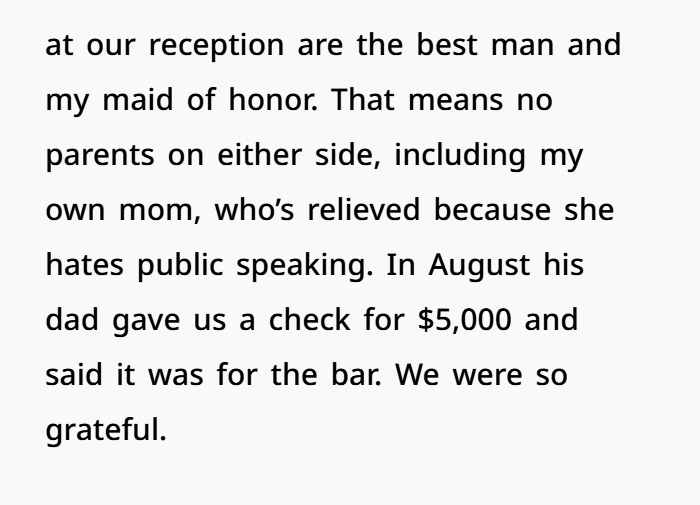
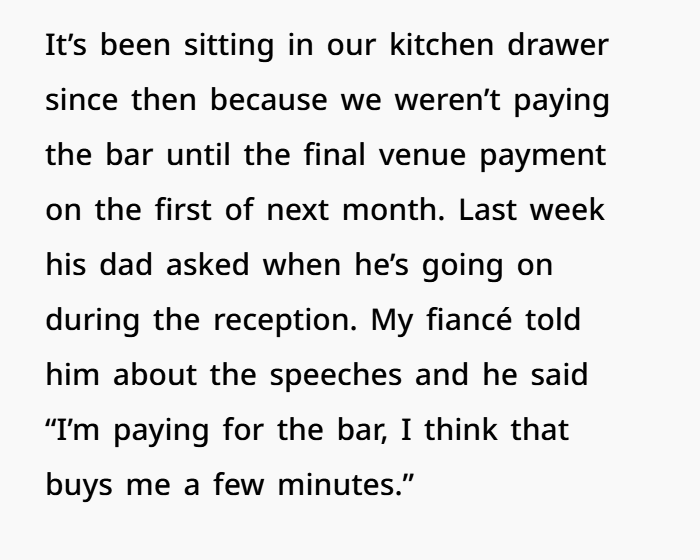
A couple planning their November wedding was happy when the groom’s father offered them $5,000 to help cover the reception bar expenses. They had already decided that only the best man and maid of honor would give speeches at the wedding. Neither set of parents would speak, so the rule was the same for both families. In August, the groom’s father gave them a check and said it was his contribution toward the wedding reception. The couple thanked him and kept the check in a kitchen drawer. They planned to use the money when their final wedding venue payment was due.
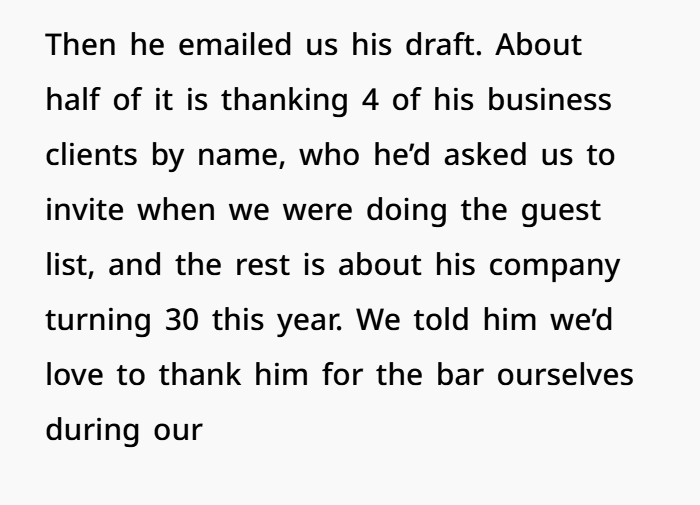
Things became uncomfortable when the groom’s father asked when he would be giving his speech. The couple explained that parents were not included in the wedding speech schedule. However, he believed his $5,000 contribution should allow him to speak at the reception. He even sent them a copy of his speech by email. When they read it, they were surprised to see that much of it was about his business. Half of the speech thanked four of his business clients, while the rest talked about his company’s 30th anniversary. Those same clients had already been added to the wedding guest list at his request. The couple felt their special day was becoming more about his business than their marriage.
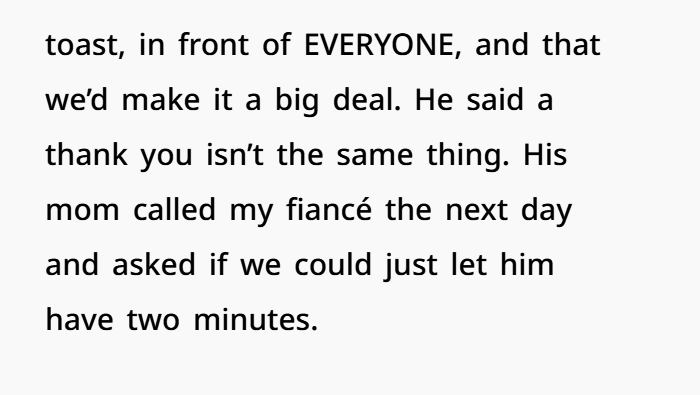
The couple wanted to handle the situation politely, so they offered another idea. During their own wedding toast, they would thank him in front of everyone for helping with the reception costs. They hoped this would show their appreciation without changing the wedding program. But the groom’s father refused because he wanted to give his own speech. The groom’s mother also called and asked them to allow him just two minutes. After discussing their wedding plans and budget, the couple decided it would be better to pay the bar expenses themselves rather than accept money with extra conditions.
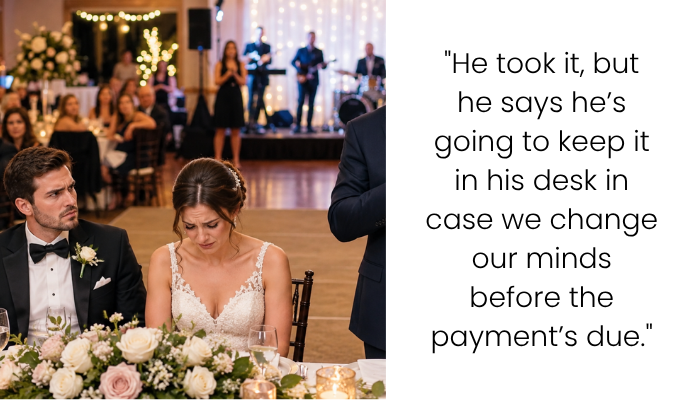
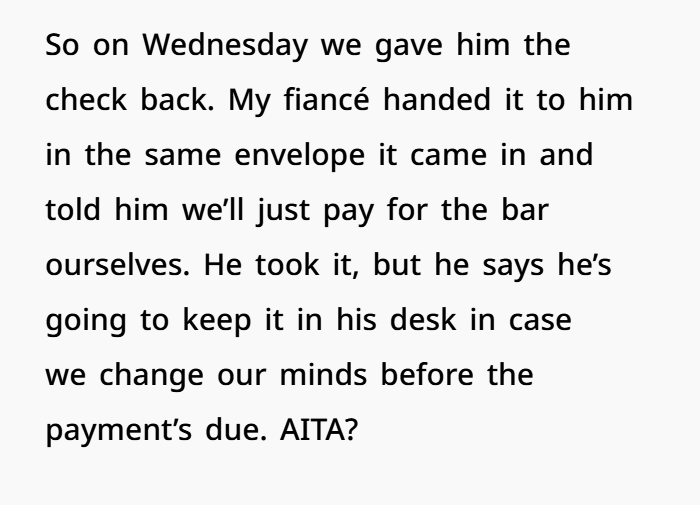
On Wednesday, the groom returned the original $5,000 check in the same envelope. He told his father that they appreciated the offer but would handle the wedding reception payment on their own. His father accepted the envelope but said he would keep the check in his desk in case they changed their minds before the venue payment deadline. Now the couple is wondering whether they made the right choice. They wanted to protect their wedding plans and keep the same rules for everyone, but they also worry that returning such a generous gift may have been too much.

Father-in-Law Offers $5,000 for Wedding, Then Demands a Speech About His Business
Planning a wedding can be expensive. So when a family member offers to help with the costs, most couples are happy to accept.
But what happens when that money comes with unexpected expectations?
One couple found themselves in an uncomfortable situation after the groom’s father offered $5,000 to help pay for the wedding reception bar.
At first, the money seemed like a kind gift.
There was no mention of special requests or conditions.
But as the wedding got closer, the father-in-law decided that his contribution should give him a chance to speak during the reception.
And when the couple read his planned speech, they discovered that much of it wasn’t even about their wedding.
Instead, he wanted to talk about his business, thank four clients, and celebrate his company’s 30th anniversary.
The couple eventually decided to return the $5,000 check rather than change their wedding plans.
Now the family is divided over whether they made the right decision.
The $5,000 Wedding Gift Started as a Kind Offer
Weddings come with plenty of expenses.
Between the wedding venue, catering services, photography, decorations, and reception costs, the final bill can grow quickly.
That’s why financial help from parents can make such a difference.
In this case, the groom’s father offered $5,000 in August to cover the reception bar.
The couple understood it as help with their wedding budget.
They appreciated the offer and accepted the check.
But there was no agreement that the money would give him a speaking role.
That detail became important later.
The couple believed they were accepting a financial gift.
The father-in-law seemed to believe the contribution gave him some say in how the reception would be organized.
Those two expectations were never discussed when the money was offered.
The Father-in-Law Wanted Time With the Microphone
As the wedding approached, the groom’s father asked to give a speech during the reception.
The problem was that the couple had already decided not to have speeches from parents.
Their wedding reception schedule was planned without speaking roles for either side of the family.
That included the bride’s parents and the groom’s parents.
The rule wasn’t aimed at one person.
It applied to everyone.
But the father-in-law wasn’t happy with the decision.
He believed his $5,000 contribution should earn him a few minutes with the microphone.
That changed the situation.
Instead of simply offering support, he was now connecting the money to something he wanted in return.
The couple offered to thank him publicly for his generosity.
But he still wanted to give his own speech.
The Planned Wedding Speech Was Mostly About His Business
A parent wanting to give a wedding toast isn’t unusual.
Many parents enjoy sharing memories, thanking guests, and wishing the newlyweds a happy future.
But this particular speech had an unexpected focus.
According to the couple’s account, the father-in-law submitted a draft that barely discussed the bride and groom.
About half of it focused on thanking four business clients.
The rest talked about his company’s 30th anniversary.
That left the couple wondering why their wedding reception was becoming a place for a business announcement.
The four clients had already been invited at the father-in-law’s request.
Now he wanted to mention them during the celebration.
It’s possible he simply wanted to recognize people who had supported his career.
But the couple had planned the reception to celebrate their marriage.
They didn’t want part of their wedding program to feel like a business networking event.
And that concern is understandable.
Why Wedding Speeches Should Fit the Celebration
Wedding speeches can be one of the most memorable parts of a reception.
A good toast usually focuses on the couple.
It might include a funny family memory, a few kind words, or a wish for their future.
The goal is to celebrate the newlyweds.
Of course, every family has different traditions.
Some weddings include several speeches.
Others have only one or two.
And some couples prefer to skip speeches completely.
There isn’t one rule that works for every wedding.
The important thing is that the couple agrees on the reception schedule.
In this case, the bride and groom had already decided not to include parental speeches.
The father-in-law’s request would have meant making an exception.
And because his speech focused heavily on his business, the couple had another reason to feel uncomfortable.
Can a Wedding Gift Come With Conditions?
Financial gifts can sometimes create confusion in families.
One person may think they are simply helping.
Another may believe the money gives them a voice in important decisions.
Social psychologist Robert Cialdini has written about reciprocity, the idea that people often feel a need to return favors.
For example, when someone gives a generous gift, the recipient usually wants to show appreciation.
That might mean saying thank you, writing a thoughtful note, or recognizing the person’s kindness.
But appreciation doesn’t always mean agreeing to every request.
The couple was happy to thank the father-in-law for his contribution.
They just didn’t want to change their reception plans.
From their point of view, the $5,000 had been offered as help with wedding expenses.
It hadn’t been presented as a payment for microphone time.
That’s why the later demand caused so much tension.
Why Money Can Create Family Pressure
Money can affect family relationships in unexpected ways.
Parents sometimes help adult children with weddings, home purchases, or other major expenses.
These contributions can be generous and meaningful.
But problems may arise when financial support comes with expectations that were never discussed.
A parent might believe paying for wedding catering gives them a say in the menu.
Someone helping with a wedding venue deposit might expect to invite extra guests.
Another family member may want control over decorations or the reception schedule.
These disagreements often happen because people have different ideas about what the money means.
The person giving it may see it as a contribution that deserves influence.
The couple may see it as a gift.
Neither side should have to guess.
Clear communication before accepting money can prevent a lot of confusion.
Why the Couple Decided to Return the Check
Instead of continuing to argue about the speech, the couple made a different decision.
They returned the $5,000 check.
The check had not been cashed, so they were able to give it back without trying to recover money they had already spent.
They also agreed to pay for the reception bar themselves.
That was a significant financial decision.
An extra $5,000 can make a big difference to a wedding budget.
It could affect savings, other wedding expenses, or financial plans after the celebration.
But the couple decided that keeping control over their reception schedule mattered more than accepting the contribution.
Returning the check also removed the main reason the father-in-law was using to demand a speech.
He could no longer argue that the money should give him a special role.
Was Returning $5,000 Too Extreme?
Some people may think returning the check was unnecessary.
After all, the father-in-law was asking for only a few minutes.
And $5,000 is a lot of money to turn down.
But the disagreement wasn’t only about the length of the speech.
The couple had already made a decision about their wedding reception.
They had also offered to thank him publicly.
He still wanted the microphone.
And the speech he submitted focused more on business clients than the marriage.
From the couple’s point of view, accepting the money while refusing his request would have kept the disagreement going.
Returning the check gave them a clear way to move forward.
They weren’t stopping him from attending the wedding.
They weren’t asking him to change his feelings.
They simply chose not to keep money that had become connected to an unwanted condition.
Why the Groom’s Mother Asked for a Compromise
The groom’s mother later asked the couple to reconsider.
She suggested allowing the father-in-law to speak for just two minutes.
At first, that might sound like a simple solution.
Two minutes isn’t very long.
But the couple’s concern wasn’t only about time.
They had already decided against parental speeches.
Making an exception for one parent could lead to questions from other family members.
The bride’s parents might wonder why they weren’t given the same opportunity.
The couple could also feel pressured to make more changes.
And the original speech still wasn’t focused on the newlyweds.
A compromise can work when everyone is comfortable with it.
But it becomes harder when one person feels they must agree because money is involved.
Does Paying for a Wedding Give Someone More Control?
This is a common question when parents help with wedding costs.
If someone pays for part of the celebration, should they get to make decisions?
The answer often depends on what everyone agreed to beforehand.
For example, parents might offer to cover wedding catering in exchange for inviting a few family friends.
If the couple agrees before accepting the money, everyone understands the arrangement.
But that’s different from adding new conditions after the gift has been offered.
In this case, the father-in-law originally said the $5,000 was for the reception bar.
He didn’t say that accepting the money meant giving him a speech.
The couple couldn’t agree to a condition they hadn’t been told about.
That’s why discussing financial expectations early is so important.
It helps couples plan their wedding budget without unexpected family disagreements.
What Does the Law Say About Wedding Gifts?
There can also be legal questions when money is given to help pay for a wedding.
Under general U.S. legal principles, a gift and a contract are not the same thing.
A gift is usually given without expecting a specific service in return.
A contract generally involves an agreement between the people involved.
If someone clearly offers money in exchange for something, both sides can decide whether to accept that arrangement.
But a person generally cannot assume that a new condition becomes legally binding simply because they mention it later.
The exact rules depend on the situation and local laws.
The fact that the couple had not cashed the check may also matter.
In this case, returning the money helped them avoid a bigger disagreement about what the payment meant.
For couples dealing with large financial contributions or complicated agreements, a qualified attorney can explain the legal details.
Why Wedding Budget Planning Can Prevent Problems
One lesson from this situation is that couples should be careful when accepting money for major wedding expenses.
Financial help can be wonderful.
But it’s useful to understand whether the contribution is a gift or comes with expectations.
Couples can discuss this before making wedding deposits or signing vendor contracts.
For example, they might clarify who is paying for the wedding venue, catering, bar service, photography, and other costs.
They can also explain which decisions they want to make themselves.
Keeping a clear wedding budget helps everyone understand the financial side of the celebration.
And written agreements can be useful when large amounts of money are involved.
This doesn’t mean family members should treat every gift like a business deal.
It simply means that clear expectations can protect relationships from unnecessary misunderstandings.
Could This Affect the Family Relationship After the Wedding?
The wedding will eventually be over.
But the family relationship will continue.
The father-in-law may feel hurt that the couple returned his check and refused his request.
The couple may feel disappointed that his generosity became connected to a demand.
Both sides may need time to move past the disagreement.
A calm conversation after the wedding could help.
The father-in-law could explain why giving a speech mattered so much to him.
The couple could explain why they wanted to keep their reception schedule unchanged.
Understanding each other’s feelings doesn’t mean everyone has to agree.
It simply creates a chance to rebuild trust.
The couple can still appreciate the father’s original offer without accepting conditions they never agreed to.
And the father-in-law can still celebrate his son’s marriage without giving a speech.
Final Thoughts
This family disagreement began with a generous $5,000 contribution toward a wedding reception bar.
But things changed when the father-in-law decided that his financial help should give him time with the microphone.
The situation became even more uncomfortable when his planned speech focused heavily on business clients and his company’s anniversary.
The couple had already decided not to include parental speeches.
Rather than change their plans, they returned the uncashed check and agreed to pay for the bar themselves.
It was an expensive decision, but it allowed them to keep the reception they had planned.
A financial gift can be a wonderful way to support a couple, but it shouldn’t automatically give the giver control over their wedding.
Clear expectations, honest conversations, and respect for boundaries can make family celebrations much easier.
And sometimes, paying an expense yourself may feel better than accepting help that comes with unexpected conditions.
Comments You Can’t Miss