
Woman Lists $1,900 in Family Dinner Bills After Father-in-Law Asks to Split the Check on Her Birthday
A woman was left frustrated after her father-in-law suggested splitting a restaurant bill for the first time in nearly a year. What made the moment even more upsetting was that it happened on her birthday.
For 11 months, the woman and her husband had been paying for regular family dinners with his parents. They had spent around $1,900 without asking for a single dollar back.
But when a $182 bill arrived during her birthday dinner, her father-in-law suddenly thought the cost was too high.
Instead of staying quiet, the woman opened her banking app and started reading out every restaurant payment the couple had made since his parents moved to town.
Her response left her father-in-law embarrassed, her mother-in-law uncomfortable, and her husband caught between supporting his wife and keeping peace with his parents.
The situation soon turned into a bigger question about family relationships, financial boundaries, and who should pay when relatives go out to eat together.

A Kind Welcome Slowly Became an Expensive Family Routine
The trouble started with something simple. A married couple wanted to help the husband’s parents feel at home after they moved to the same town last November.
They began inviting them out for dinner about once a month. It was a nice way to spend time together and help the older couple settle into their new surroundings.
Most of their meals took place at three or four familiar restaurants nearby. These weren’t expensive fine-dining spots, but paying for four people every month still cost a fair amount.
And there was one detail that eventually became hard to ignore.
The woman and her husband paid the entire restaurant bill every single time.
For 11 months, her father-in-law never offered to cover dinner or even split the check.
There had been one chance to change that arrangement. Back in March, her mother-in-law suggested sharing the cost. But her husband quickly dismissed the idea.
He argued that since the younger couple had invited them, they should be the ones paying.
Nobody brought it up again.
The woman didn’t want to start an argument over money. She also didn’t want family dinners to become uncomfortable.
So she kept paying, hoping her father-in-law would eventually offer to treat everyone without being asked.
That offer never came.
Her Birthday Dinner Was Supposed to Be Something Special
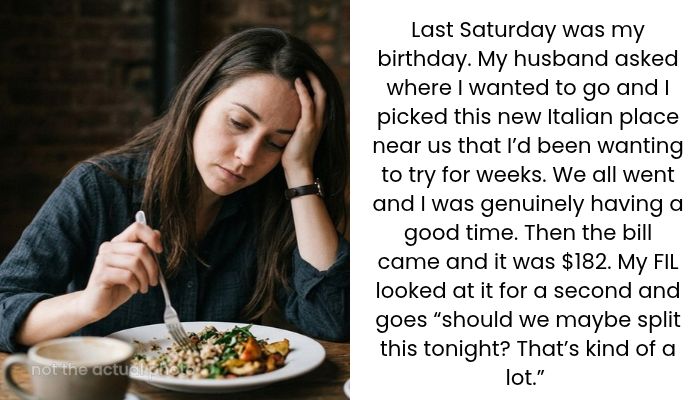
Last Saturday, the woman celebrated her birthday.
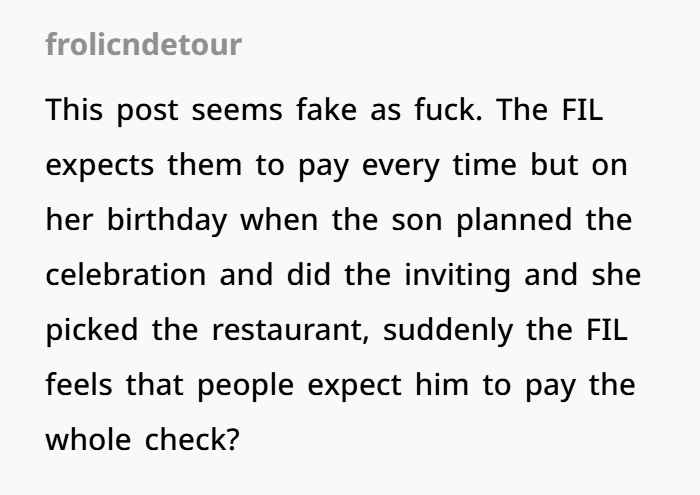
Her husband asked where she wanted to eat, and she chose a new Italian restaurant nearby. She had been looking forward to trying it for weeks.
The couple invited his parents along, just as they had done for months.
At first, everything went well. They enjoyed their meal, and the birthday celebration seemed to be going smoothly.
Then the server brought the check.
The total was $182.
Her father-in-law looked at the amount and suggested that everyone split the bill because it seemed expensive.
For the woman, the timing was hard to believe.
After nearly a year of accepting free dinners, he had suddenly become concerned about the cost on the one evening meant to celebrate her birthday.
It wasn’t simply about the $182.
It was about all the earlier meals, the money they had spent, and the fact that he had never once offered to help.
She Opened Her Banking App and Started Counting
Instead of arguing about the birthday dinner alone, the woman decided to show her father-in-law exactly how much the couple had already paid.
Right there at the restaurant table, she opened her banking app and searched through their past dining charges.
She went back to November, when her in-laws first moved to town.
Then she began reading out the restaurant names and the amounts they had paid.
One dinner after another, she worked through all 11 restaurant bills.
By the time she finished, the total was around $1,900.
That number changed the conversation.
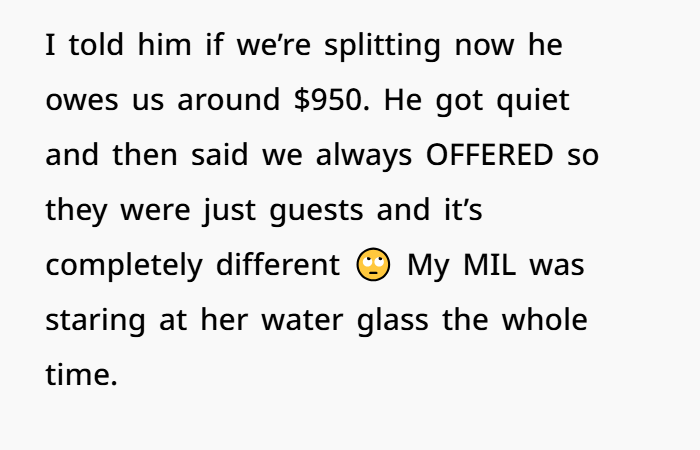
The woman told her father-in-law that if they were going to start splitting dinner costs, he owed the couple about $950 for the earlier meals.
Of course, she wasn’t presenting a formal debt agreement. She was making a point about how much the couple had spent while his parents contributed nothing.
Still, hearing nearly a year’s worth of expenses listed in front of everyone clearly caught her father-in-law off guard.
Her Father-in-Law Said the Previous Dinners Were Different
After hearing the total, the father-in-law went quiet.
But he didn’t agree with her argument.
Instead, he pointed out that the couple had always offered to take them out. In his view, that made him and his wife invited guests, not people who were expected to share the bill.
He believed those earlier dinners were different because nobody had asked them to pay.
The woman clearly saw things another way.
She felt that accepting free meals for nearly a year without ever offering to return the favor was unfair. And choosing her birthday to bring up splitting the bill only made it worse.
Meanwhile, her mother-in-law stayed quiet and stared at her water glass.
It was an awkward moment for everyone at the table.
Her Husband Supported Her, but Had One Concern
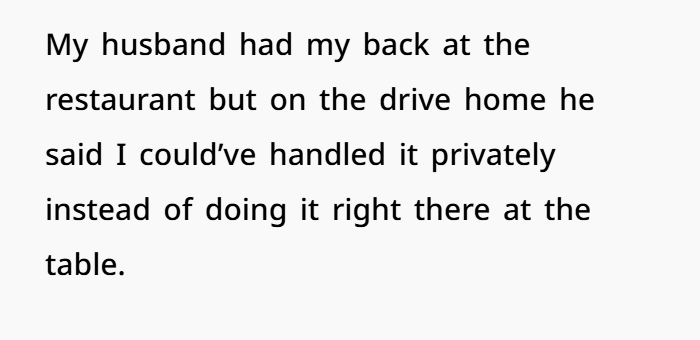
The woman’s husband stood by her during the restaurant disagreement.
But later, during their drive home, he admitted that he wasn’t completely comfortable with how things had happened.
He felt she could have discussed the issue privately rather than listing every payment in front of his parents.
That left the couple with two separate problems.
One was the money they had spent on family dinners. The other was how the woman had confronted his father.
The next morning, things became even more uncomfortable.
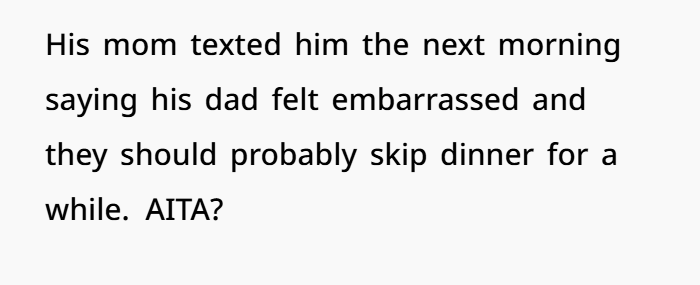
Her mother-in-law sent her son a text saying his father felt embarrassed by what had happened.
She also suggested that the family should stop going out for dinner together for a while.
What had started as a birthday celebration had now created tension between the couple and his parents.
Who Should Pay When Family Members Go Out to Dinner?
The disagreement raises an interesting question about restaurant bill etiquette.
According to the Emily Post Institute, there is a difference between inviting someone out as a guest and simply arranging for a group to eat together.
When someone clearly offers to host a dinner, guests can usually expect that person to pay. But when people agree to meet at a restaurant, everyone may be responsible for their own meal.
That gives the father-in-law’s argument some support. The couple had invited his parents and paid without asking for money.
But the situation becomes more complicated when the same arrangement continues for nearly a year.
The woman wasn’t upset about treating her in-laws once or twice. She was frustrated that the kindness had become a regular expense without anyone discussing it.
There was also the birthday issue.
The Emily Post Institute’s birthday dinner etiquette guidance explains that when a group arranges a celebration for someone, the guests generally share the cost of treating the birthday person.
In this case, the woman’s husband arranged the outing, and she chose the restaurant. That makes the payment expectations less clear.
Still, after accepting 11 dinners, the father-in-law’s decision to raise the cost issue on her birthday was bound to feel disappointing.
Why Money Problems Can Hurt Family Relationships
The story also shows how quickly small money concerns can turn into bigger family disagreements.
The Consumer Financial Protection Bureau explains that unclear money arrangements between relatives can create stress and damage relationships.
Its guidance encourages families to discuss financial expectations early, even when those conversations feel uncomfortable.
That advice fits this situation.
The couple never clearly explained that they wanted his parents to contribute to future dinners. Meanwhile, the father-in-law believed that being invited meant he wasn’t expected to pay.
Both sides had different expectations, but neither had properly discussed them.
The woman eventually reached a point where she couldn’t ignore the issue any longer.
Unfortunately, that conversation happened during her birthday dinner, with everyone sitting around the same table.
Was Reading Out the $1,900 in Dinner Bills Going Too Far?
There are two sides to the woman’s reaction.
On one hand, her frustration makes sense. She and her husband had paid for every family dinner, and the first suggestion to split a check came during her own birthday celebration.
Her father-in-law may not have meant to upset her, but the timing made his comment difficult to accept.
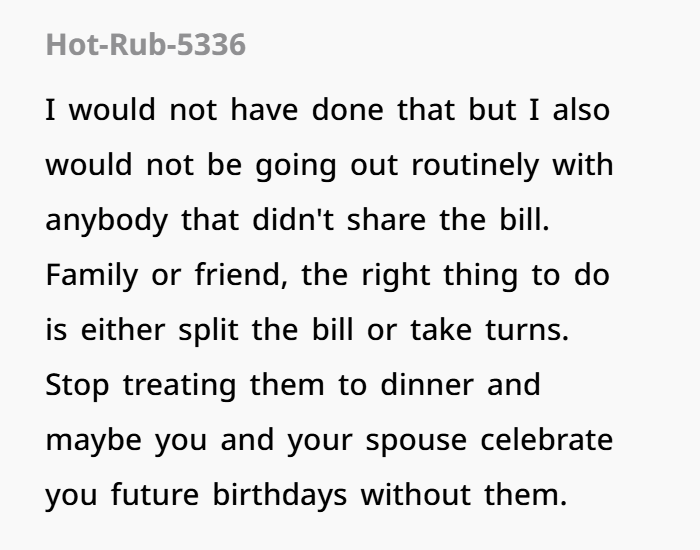
On the other hand, the previous meals had been offered without an agreement that his parents would repay the money.
Asking for $950 afterward was a way to highlight the unfairness she felt. It wasn’t the same as collecting money that had been promised.
Her husband’s concern also deserves some attention.
He supported his wife but believed a private conversation could have made the same point without embarrassing his father.
The Consumer Financial Protection Bureau’s guidance on family financial arrangements suggests that clear expectations and calm conversations can help protect relationships when money becomes a problem.
For this family, discussing how to handle future restaurant expenses might have prevented the disagreement.
But that conversation never happened until emotions were already running high.
The Family Dinner Tradition Is Now on Hold
The mother-in-law’s message the next morning suggests that the birthday argument had a lasting effect.
Her husband felt embarrassed, and she thought it would be better to stop the monthly dinners for a while.
The woman now faces an uncomfortable situation. She wanted her in-laws to understand how much she and her husband had contributed, but her response also created tension in the family.
There is no update in the original account about whether the father-in-law apologized, whether anyone paid the $950, or whether the family eventually returned to their monthly dinners.
For now, the biggest question isn’t really about the money.
It’s about whether the woman was wrong to bring up nearly a year’s worth of restaurant bills in front of everyone, or whether her father-in-law should have shown more appreciation long before her birthday arrived.
See the comments to know what people said

What started as a simple birthday dinner turned into an uncomfortable family argument over money, fairness, and respect.
For 11 months, the woman and her husband had happily paid for meals with his parents. They never asked for money back. But when her father-in-law suggested splitting the $182 bill on her birthday, she finally lost her patience.
Reading out nearly $1,900 in restaurant expenses may have embarrassed him, but it also showed just how much the couple had spent without receiving an offer to share the cost.
Still, her husband’s concern wasn’t unreasonable. A private conversation might have avoided some of the hurt feelings while making the same point.
The real problem seems to have been the lack of clear financial boundaries and family communication. What began as a kind gesture slowly became an expectation, and nobody talked about it until things got heated.
Now, the family’s monthly dinner tradition is on hold, and everyone is left dealing with the awkward aftermath.