
My Brother’s Fiancée Said Her Husband Was Dead—But I Just Found Him Alive
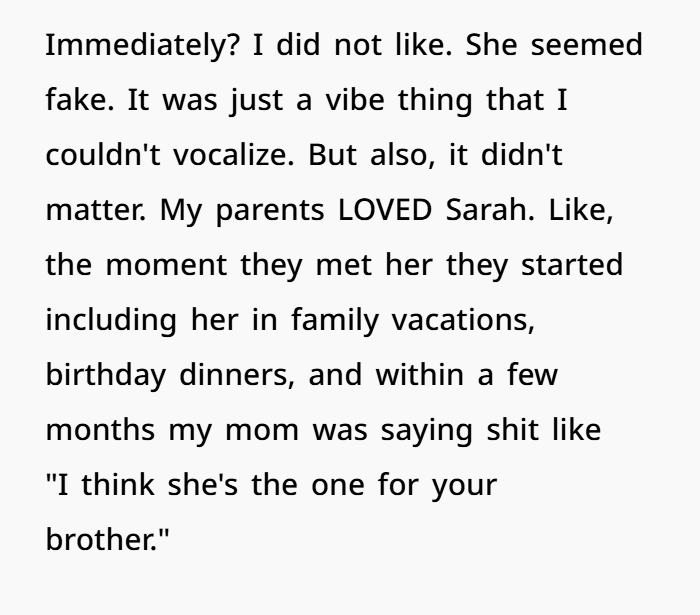
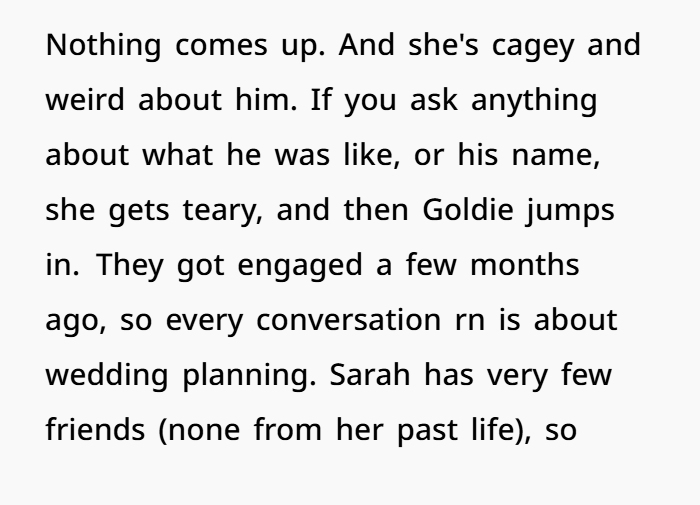
The OP, a 24-year-old woman, shares a surreal and unsettling family drama involving her older brother (35M) and his fiancée (32F-ish), Sarah. Sarah, who entered the family’s life two years ago, claimed to be a grieving widow whose husband died suddenly from a rare heart condition. Her tragic backstory garnered instant affection and trust from OP’s family—particularly from her “golden boy” brother and doting parents. However, OP has always felt something off about Sarah, describing her as “fake” and overly secretive, especially regarding her past.
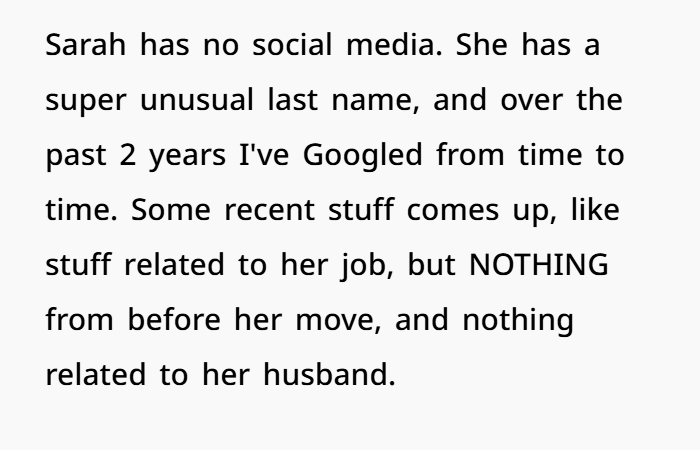
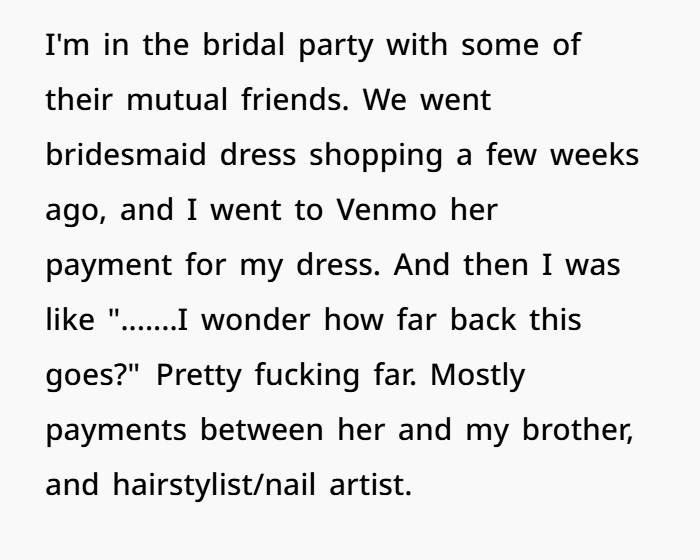
Driven by intuition and curiosity, OP did some light online sleuthing over the years but came up empty. That changed during a recent bridal party event, when OP stumbled upon Sarah’s Venmo account. Digging into past transactions, OP found a payment from a man—one who turned out to be Sarah’s very much alive “dead” husband. A quick Instagram search revealed recent photos, including their wedding photo from 2017, and the man is not only alive but remarried with kids. OP has gathered screenshots as proof and now faces a major moral and emotional dilemma: tell her brother, confront Sarah, or stay silent?
We are taught that lies are a big no-no, but sometimes, it is a necessary evil to cover up something much more traumatic

A woman’s gut instinct about her brother’s ‘widowed’ fiancée led her to do some digging about the woman’s secretive past
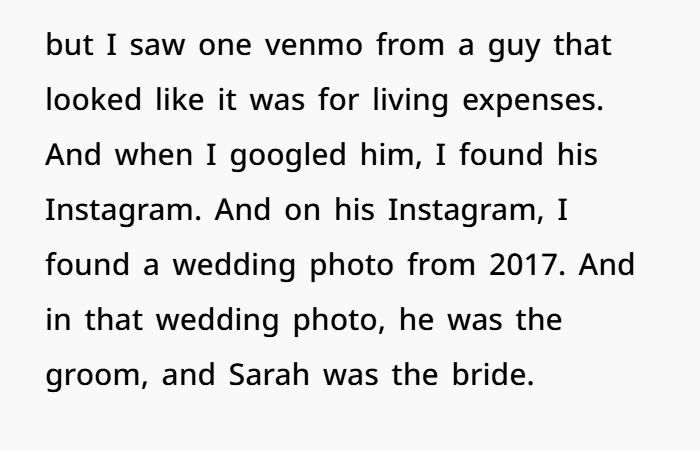
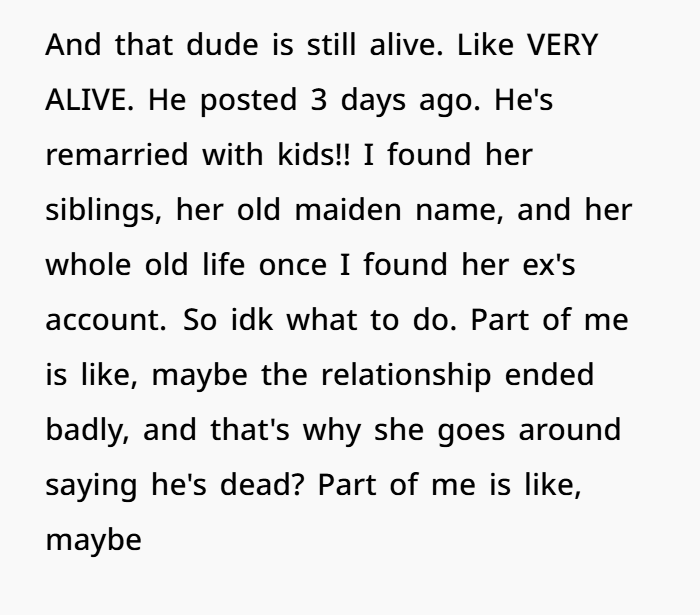
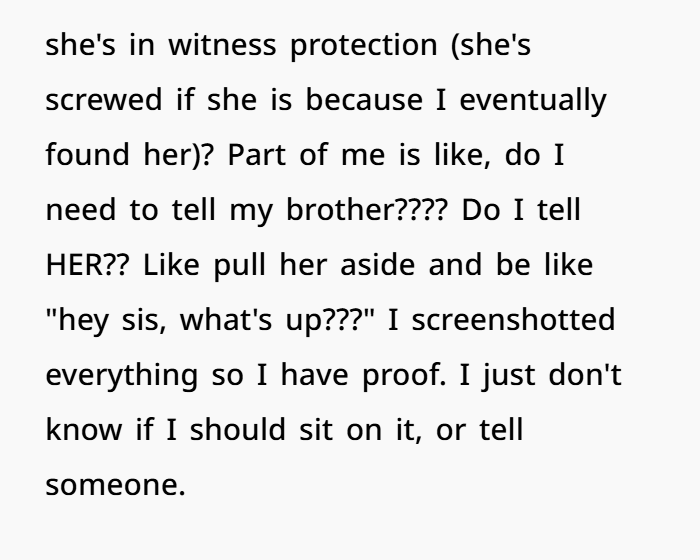
Let’s be honest: this story reads like a Netflix thriller with a wild twist. A woman claims her husband died suddenly, uses that tragedy to start over, and builds a new life—only to have someone discover that not only is he alive, he’s thriving. But while this sounds like prime entertainment, the emotional and ethical mess it leaves behind is very, very real.
This isn’t just a white lie. It’s a fabrication of identity, and it could have massive implications—emotionally, legally, and psychologically. So, let’s break this down.
1. When Grief Becomes a Persona: Munchausen by Relationship?

What Sarah seems to have done—assuming this wasn’t some misunderstanding—is emotional manipulation by playing the role of the grieving widow. There’s no known mental disorder specific to faking widowhood, but this is adjacent to factitious disorder, sometimes called Munchausen syndrome, where individuals feign illness or trauma for sympathy or attention.
People who fake tragic backstories often do so for emotional validation, social leverage, or to quickly build trust and intimacy. The role of “tragic widow” is especially powerful—it can make people see you as resilient, romantic, and emotionally deep, even if you don’t share much.
What’s chilling here is how complete the lie was: she cut off her old friends and family, changed states, got rid of her digital past, and even avoids direct questions about her late “husband.” That’s not just self-protection. That’s curated deception.
2. Why the “Dead Husband” Lie is Dangerous—Legally and Emotionally
Let’s get into some real-world implications. Telling people your husband died when he didn’t isn’t just weird—it could be legally risky, depending on context.
- Fraud: If she used her widowhood to claim any benefits—like life insurance, spousal support, or even just social housing or grants—she could be guilty of fraud.
- Marriage Status: If she legally claimed widowhood, but was actually divorced, that’s perjury on some legal forms. And if she wasn’t legally divorced when she started dating OP’s brother, that could bring bigamy into the equation.
Even if none of that is happening (and let’s hope not), the emotional damage this could cause is huge. OP’s brother is building a life with someone who faked her entire backstory. Their bond was likely strengthened by what he thought was shared healing from grief.
Think about this: your partner lies about something as massive as a dead spouse. What else are they capable of hiding?
3. Could There Be a “Reasonable” Explanation?
Let’s play devil’s advocate. Could Sarah have had a legit reason to fake this?
- Trauma Response: Maybe the relationship was abusive, and instead of explaining the details, she created a cleaner story. But if that’s the case, why lie about death? Most people say “we don’t speak” or “we’re estranged.”
- Witness Protection or Escaping Abuse: If she’s in witness protection or hiding from a dangerous situation, then yeah—lying makes sense. But again, the issue is that she got close to a whole new family. If she were in that kind of danger, exposing herself through a wedding and family photos would defeat the point.
- Shame or Embarrassment: Some people rewrite their past out of shame. Maybe she left the marriage badly or felt judged. But making someone dead is extreme. It’s one thing to avoid talking about an ex. It’s another to erase their existence while marrying someone else.
Even if there is some reason, the way she’s handled it—hiding, crying to deflect, cutting everyone off—suggests manipulation, not just trauma.
4. Should OP Say Something? The Ethics of Disclosure
This is the hardest part. OP isn’t just a sister now—she’s a keeper of a potentially devastating secret. And no matter what she decides, someone will get hurt.

Here are some angles to consider:
- Tell Sarah First (Confrontation Style): This could be the most fair—give Sarah a chance to explain herself. But also risky. If she’s manipulative or unstable, she might try to flip it, lie more, or even go nuclear and say OP is sabotaging her.
- Tell the Brother (Direct Approach): If OP’s main concern is protecting her brother, then honesty is key. It’ll hurt, yes—but better now than years down the line with shared finances, children, and potential marriage fraud.
- Tell Both (Mediated Conversation): This one’s nuclear-level drama, but sometimes sitting them both down with proof leaves no room for lies. It’s dangerous emotionally, but it ends the question mark.
- Sit on It (Risky Silence): Sure, doing nothing avoids conflict…for now. But if OP’s brother finds out later and realizes she knew, it could destroy their relationship.
Ultimately, staying silent protects the liar, not the victim.
5. Family Dynamics: The “Golden Boy” vs. The “Fuck-Up”
OP mentions being treated like the black sheep while her brother was always the golden child. That matters here. If she does come forward, there’s a real chance no one believes her. Worse, she might get blamed for “jealousy,” “drama,” or “trying to ruin things.”
That’s why having screenshots and proof is so important. Not just for drama’s sake—but for credibility. In families with strong favoritism, the “problem child” is often dismissed, even when they’re telling the truth.
But here’s a hard truth: sometimes being the one to do the right thing means being hated for a while. That doesn’t make it wrong. It makes it brave.
She confronted her brother, who revealed he already knew and that the real story was far more complicated
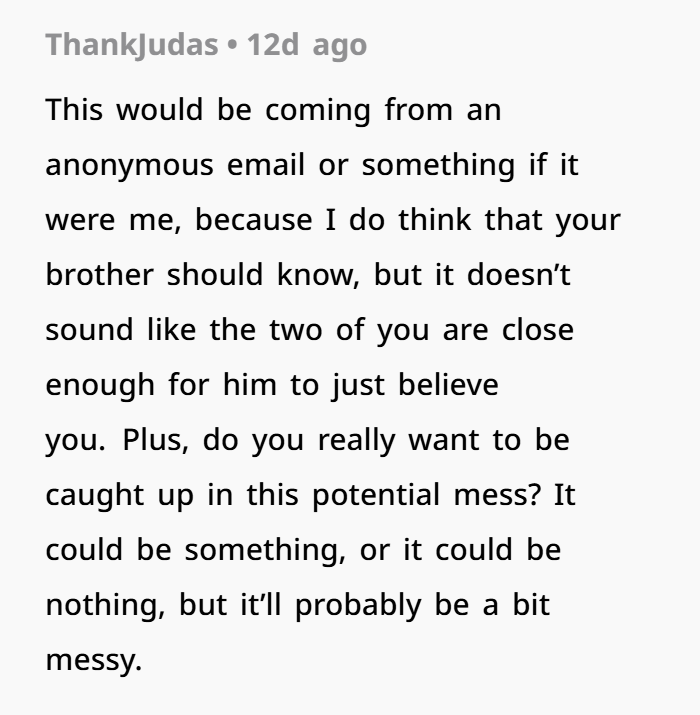
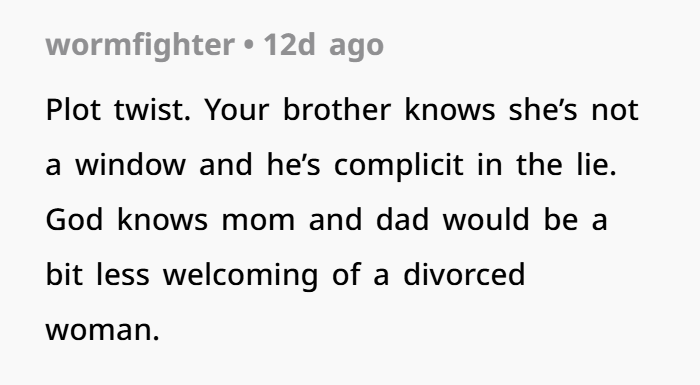
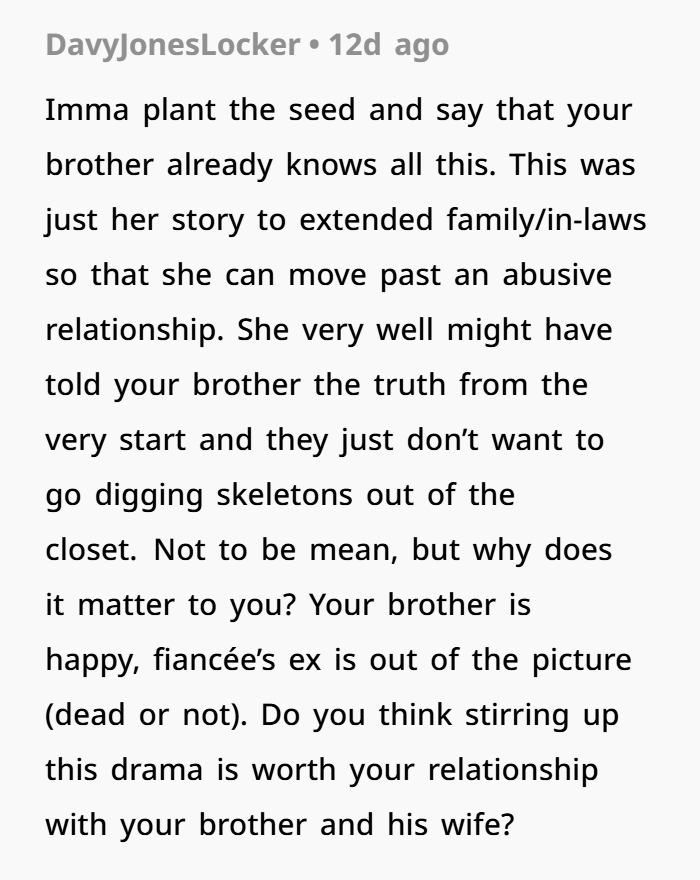
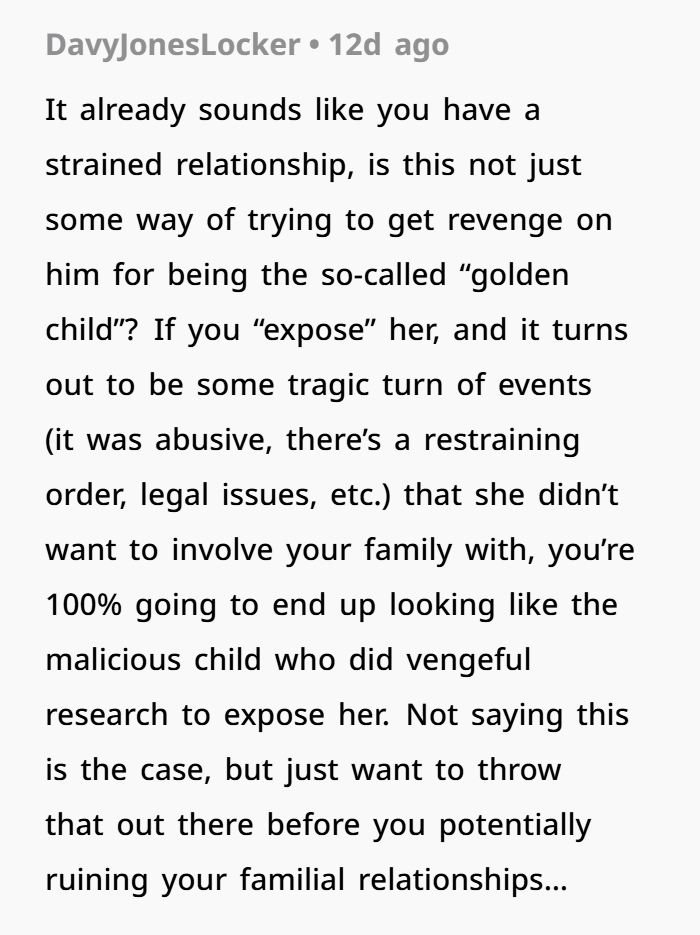
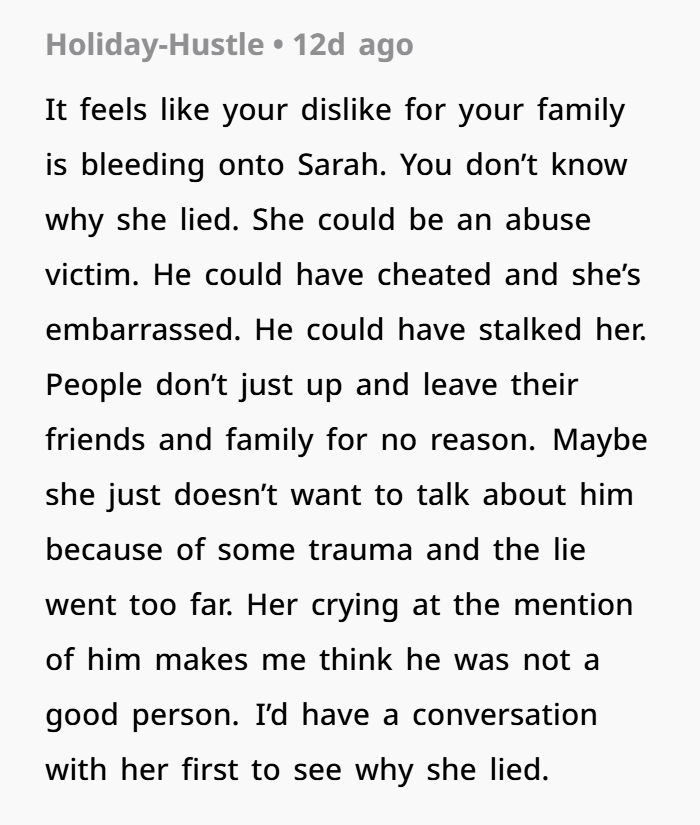
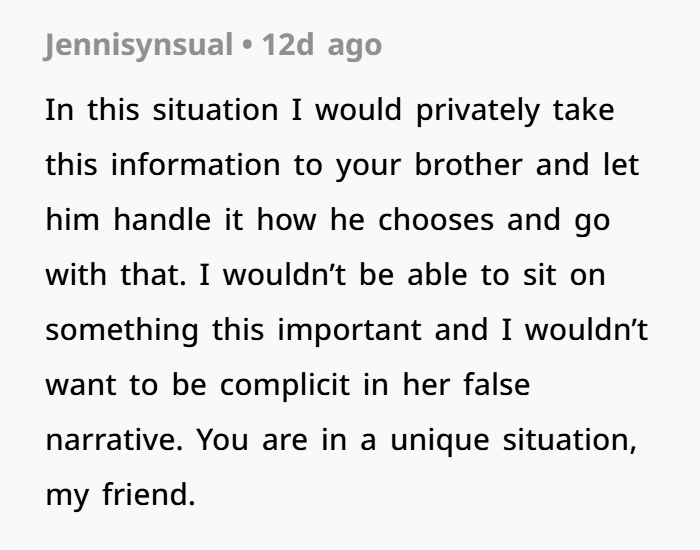
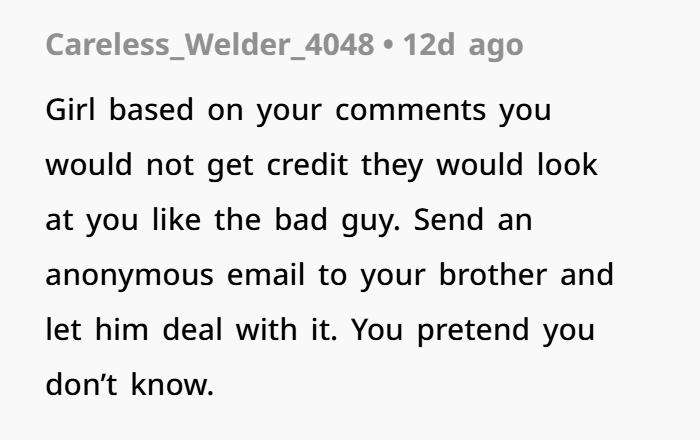
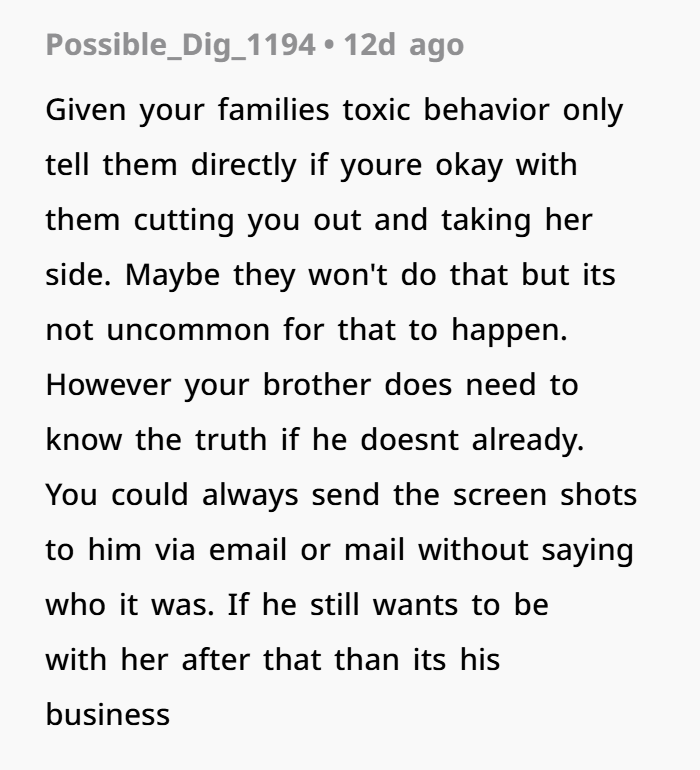
OP is holding a bombshell of a secret—and no matter what, it’s going to explode. But silence lets a lie grow. Telling the truth, hard as it is, gives her brother a chance to make informed decisions about his future.
Because marriages built on lies? They don’t just fall apart. They implode. And the longer the lie lasts, the worse the fallout.