
Woman Snaps at Sister for Bringing Up Her Traumatic Birth During Every Family Conversation
A 29-year-old woman has sparked a family disagreement after confronting her older sister for repeatedly bringing up her traumatic childbirth experience, even when other people are sharing their own painful memories.
Her 31-year-old sister welcomed a baby girl in March. What should have been a happy time for the family turned frightening when she suffered complications after a C-section and needed another surgery.
Thankfully, both mother and baby recovered well. But months later, the difficult birth remains a major part of almost every family conversation.
The younger sister understands how frightening the experience was. After all, she was there when the family feared the worst. Still, she has grown frustrated with how often her sister brings up the experience, especially when someone else needs emotional support.
Things finally reached a breaking point when her husband was talking about the upcoming first anniversary of his friend’s death in a car accident. Instead of simply listening, the older sister compared his grief to her own childbirth experience.
The younger woman lost her patience and told her sister that not every conversation needed to return to her birth story. Now, she is questioning whether she was wrong to speak so harshly or whether her sister needed to hear how her behavior was affecting the family.
The trouble began in March, when the older sister gave birth to her first child, a beautiful baby girl. Everyone in the family was excited about the new arrival, and the little girl quickly became the center of attention.
But the delivery did not go as smoothly as everyone had hoped.
The new mother needed a C-section. At first, the surgery appeared to go well. Unfortunately, she later developed complications that were serious enough to require another operation.
Her husband, younger sister, and other family members were terrified. They had no idea how things would turn out, and the experience became one of the most frightening moments the family had faced.
Thankfully, the mother recovered well, and her baby was healthy too. According to the younger sister, both have been doing well ever since.
But while the physical recovery went well, the emotional side of the experience appeared to be much harder.
The American College of Obstetricians and Gynecologists explains that a traumatic birth can affect a mother’s mental health even when she and her baby are physically healthy afterward.
For this family, the frightening delivery was something they would never forget. What they did not expect was how often it would become part of their everyday conversations.
The Sister Kept Bringing Every Conversation Back to Her Birth
As the months passed, the younger woman noticed a pattern that became harder to ignore.
Almost every time she visited her sister, the conversation somehow returned to the difficult birth.
It did not matter what the family was discussing. They could be talking about something completely unrelated to babies, pregnancy, or childbirth. Somehow, the older sister would find a way to mention that she had nearly died while giving birth.
At first, the family understood why she wanted to talk about it. After all, she had been through something frightening.
But the problem went beyond simply sharing her experience.
According to the younger sister, the new mother often brought up her childbirth complications when someone else was talking about a personal struggle.
If a family member needed to vent about something upsetting, the older sister would turn the attention back to herself. Her near-death experience became the main topic, even when someone else needed comfort.
This left the younger woman feeling frustrated.
She loved her sister and was grateful that she had survived. But she also felt that other family members deserved the chance to talk about their own problems without being interrupted or compared.
There is a difficult emotional side to situations like this.
According to the NHS guidance on post-traumatic stress disorder, people who experience frightening events may continue to struggle with painful memories long after the danger has passed.
That does not mean the older sister has PTSD. The Reddit post does not mention any diagnosis. Still, it helps explain why someone might find it difficult to move past a traumatic experience.
For the younger sister, though, the issue was not that her sibling wanted to talk about the birth. It was that she seemed unable to give anyone else the same space to share their feelings.
A Conversation About a Friend’s Death Became the Final Straw
The situation finally reached a breaking point during a family visit.
The 29-year-old woman and her husband went to see her older sister, brother-in-law, and their baby.
During the visit, the younger woman’s husband began talking about something deeply personal.
The first anniversary of his friend’s death was approaching. His friend had died in a car accident, and the loss was still painful.
With only a year having passed, he was understandably upset.
It was the kind of conversation where a person might simply want someone to listen.
But instead of focusing on his grief, the older sister brought up her own experience again.
She told him:
“i completely understand, I mean I almost died giving birth so I know how aweful that must feeling”
For the younger woman, that comment was too much.
Her husband was grieving someone who had actually died, yet her sister had once again turned the conversation toward her childbirth experience.
She felt that her husband’s pain had been pushed aside.
After months of hearing the same comparison during different family conversations, she finally lost her patience.
The Younger Sister Snapped and Told Her to Stop
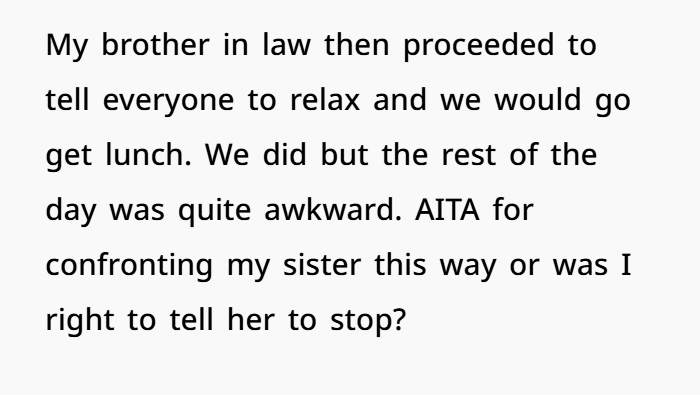
The younger woman confronted her sister in front of the family.
She told her that not every conversation needed to be about her birth story.
She also made it clear that everyone understood how traumatic the delivery had been. Nobody was denying that the experience was frightening.
But she was tired of watching her sister bring it up whenever someone else was sharing a painful experience.
The room went quiet.
Her older sister became upset and accused her of not appreciating how close the family had come to losing her.
That response only made the younger woman angrier.
She reminded her sister that she had been there during the medical emergency. She had cried and feared for her life, just like everyone else.
Of course she was grateful that her sister had recovered and that the baby was healthy.
But she felt that surviving a frightening event did not give her sister the right to dismiss another person’s grief.
The disagreement had now become about more than the birth itself. It was about how the family treated one another when someone needed emotional support.
Before the argument could grow worse, the brother-in-law stepped in.
He asked everyone to calm down and suggested that they go out for lunch.
The family agreed, but the tension did not disappear.
They spent the rest of the day together, although things felt awkward after the confrontation.
The Family Had Already Been Supporting Her Through Therapy
One detail makes this family disagreement more complicated.
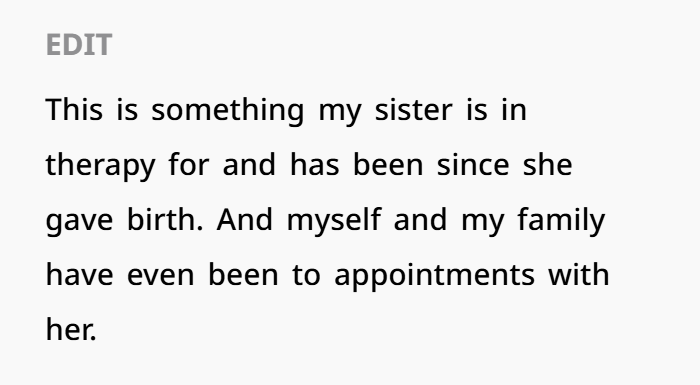
In an update to the original Reddit post, the younger woman explained that her sister was already receiving therapy for her traumatic childbirth experience.
She had been attending therapy since giving birth.
The family had not ignored her emotional struggles, either. The younger sister said that she and other family members had even attended some therapy appointments with her.
That suggests the family had been making an effort to support her recovery.
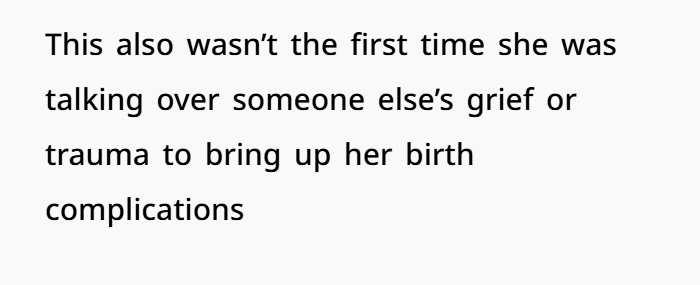
The younger woman also clarified that the conversation about her husband’s late friend was not an isolated incident.
Her sister had brought up her birth complications during other conversations about people’s grief and trauma before.
This was why the younger woman felt she had reached her limit.
Still, recovering from a frightening childbirth experience can take time.
The National Childbirth Trust’s guidance on traumatic birth explains that some parents continue to experience emotional distress after a difficult delivery. Professional support and talking therapies can help them work through those feelings.
The Scottish clinical guidance on birth trauma also recommends ongoing support and, when needed, specialist mental health care for people struggling after traumatic childbirth.
The older sister’s decision to attend therapy is a meaningful part of the story. It shows that she is already getting help for something that continues to affect her.
But it also raises a difficult question: How can a family support someone dealing with trauma while making sure everyone else’s feelings are heard?
Why the Argument Is More Complicated Than It First Appears
There are two different kinds of pain at the center of this disagreement.
The older sister survived a frightening medical emergency while giving birth. Even though she recovered physically, the memory may still feel very real to her.
The younger sister and her family also lived through that fear. They worried about losing someone they loved.
But now, the younger woman feels that her sister’s experience has started to overshadow everyone else’s struggles.
Her husband’s grief made that especially clear.
He was remembering a friend who had died in a car accident. Instead of receiving comfort, he heard another comparison to the childbirth emergency.
The older sister may have been trying to show that she understood what it feels like to face death. The Reddit post does not explain what she intended.
Unfortunately, her words came across differently to her younger sister.
This is where trauma-informed emotional support becomes relevant.
The American College of Obstetricians and Gynecologists explains that trauma can affect people’s relationships and the way they respond to difficult situations. It encourages care that recognizes emotional pain without judging or dismissing the person experiencing it.
At the same time, healthy family communication involves listening when someone else needs support.
A person can deserve kindness for their own painful experience while still being expected to respect another person’s feelings.
That seems to be the balance this family is struggling to find.
Could the Younger Sister Have Handled the Confrontation Differently?
The younger woman’s frustration is easy to understand.
She had listened to her sister’s birth story many times. She had supported her through a frightening medical emergency and even joined her at therapy appointments.
Watching her husband struggle with the anniversary of his friend’s death was especially upsetting.
Still, the timing of her response made the situation more painful.
Rather than discussing the repeated interruptions privately, she confronted her sister during an emotional family conversation.
Her older sister was hurt by the way the criticism was delivered.
A quieter conversation might have allowed both women to explain their feelings without the added pressure of arguing in front of others.
That does not mean the younger woman’s concerns were unreasonable.
It simply means that the way a difficult message is delivered can affect how someone receives it.
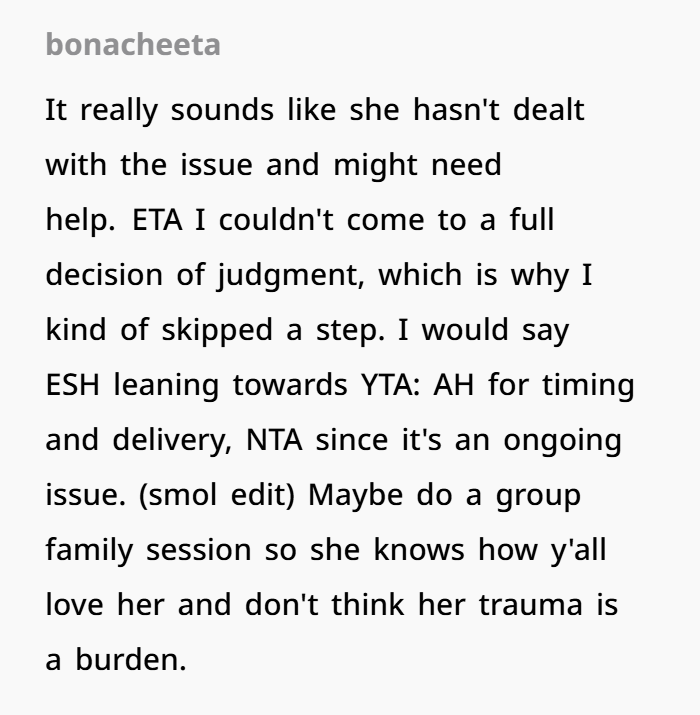
The family might also benefit from discussing this pattern during one of the therapy appointments they have already been attending, if the older sister and her therapist agree.
Resources from Postpartum Support International offer further information about birth trauma support, including peer support groups and people trained to help parents understand difficult childbirth experiences.
For this family, the challenge is not choosing whose pain matters more.
It is finding a way for the older sister to feel supported without making other family members feel that their problems are less important.
Was She Wrong to Finally Speak Up?
The younger woman turned to Reddit’s Am I the Asshole community because she was unsure whether confronting her sister had been the right decision.
She knew her sister had gone through something serious. She had seen the fear and uncertainty firsthand.
But she also believed that her husband deserved support while grieving his friend.
The disagreement leaves both sisters with something to think about.
The older sister is still working through the emotional effects of her childbirth experience. The younger sister, meanwhile, wants family conversations to feel fair and supportive for everyone.
Neither woman’s feelings erase the other’s.
The original post was marked with the community’s “Everyone Sucks” flair, although the material provided does not include individual Reddit comments or a detailed breakdown of the community’s reactions.
What makes this story difficult is that the younger woman was not asking her sister to forget what happened. She simply wanted her to recognize that other people were hurting too.
See the comments to know what people said
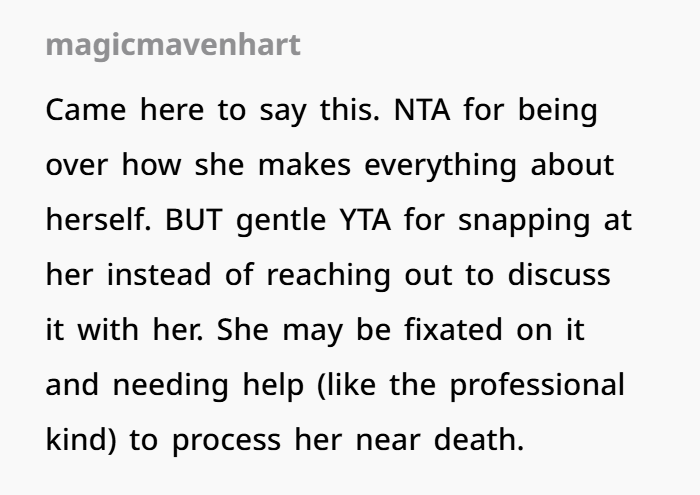
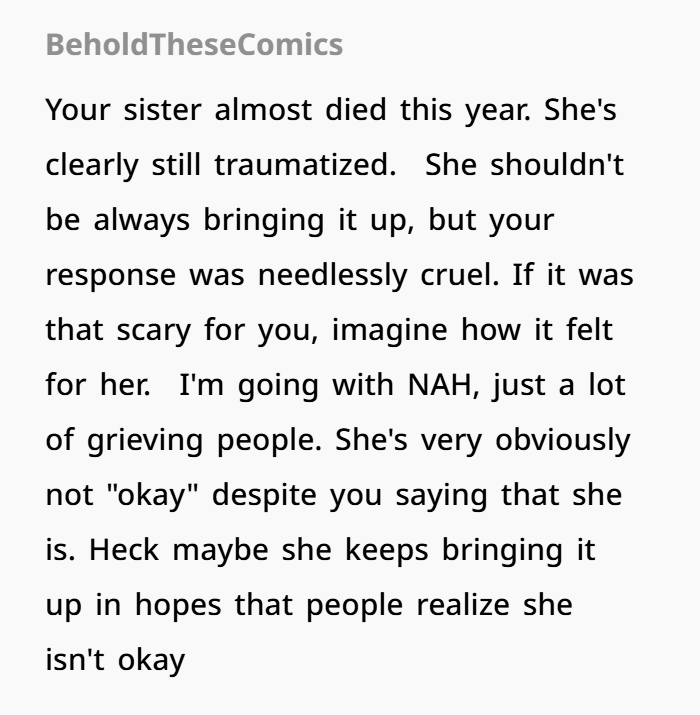
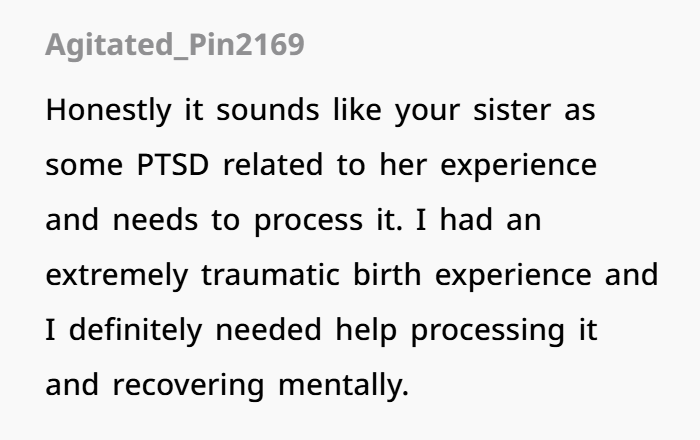
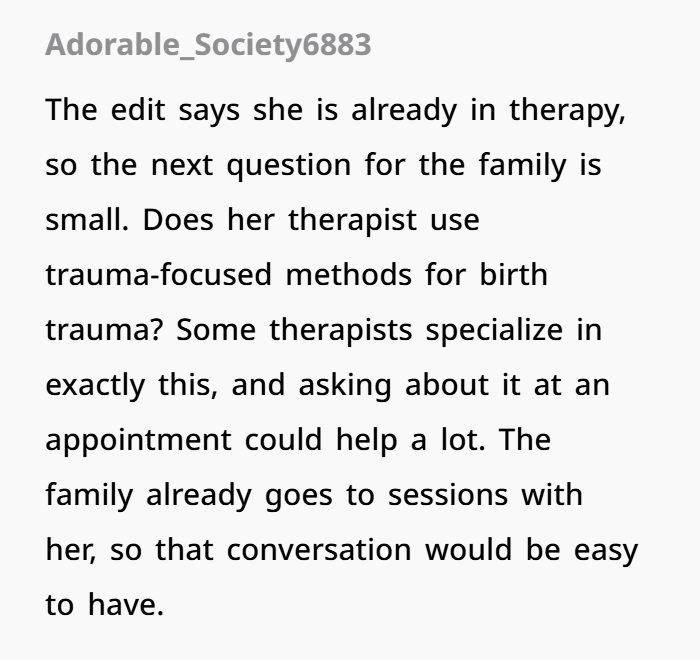
This family disagreement shows how a painful experience can affect relationships long after the danger has passed. The older sister went through a frightening childbirth and is still working through that trauma in therapy. Her feelings deserve care and understanding.
But the younger sister has feelings too. She watched her family go through a terrifying time, supported her sister’s recovery, and tried to be patient. What finally upset her was seeing her husband’s grief pushed aside during a conversation about his late friend.
Perhaps she could have chosen a calmer moment to speak up. Still, her frustration did not come from a lack of love. She simply wanted her sister to understand that other people’s pain matters too.
The two sisters may need an honest conversation about boundaries, emotional support, and listening to one another. Healing from trauma takes time, but healthy family relationships also need respect on both sides.