
Woman Spends Over $7,000 on MIL’s Groceries, Then Learns She’s Complaining About the Cheap Brands
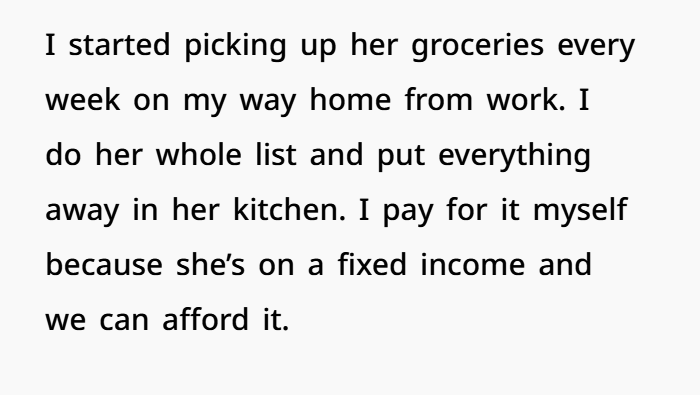
A woman is thinking about stopping her weekly grocery shopping for her mother-in-law after finding out that her help was being criticized. About a year ago, her mother-in-law had hip replacement surgery and was having trouble walking and driving. Since she lived only ten minutes away, the woman offered to pick up groceries for her on her way home from work. At first, it was just a small favor, but it soon became part of her weekly routine. She would follow her mother-in-law’s shopping list, pay for everything herself, and even put the groceries away when she arrived. She wanted to make life easier for an older family member who needed extra help with daily tasks.
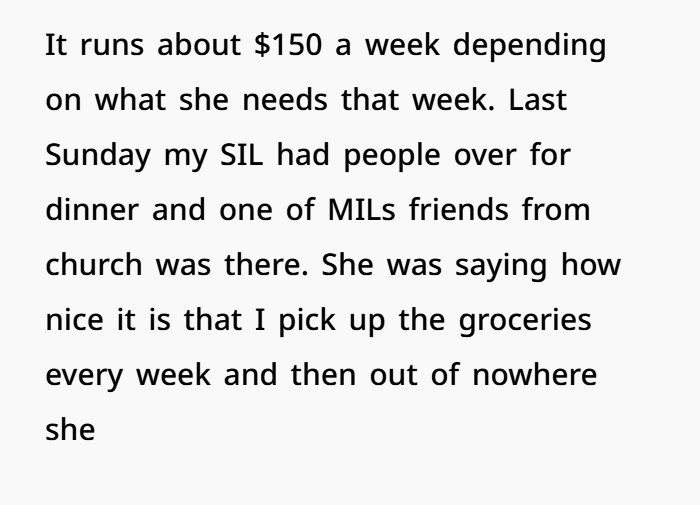
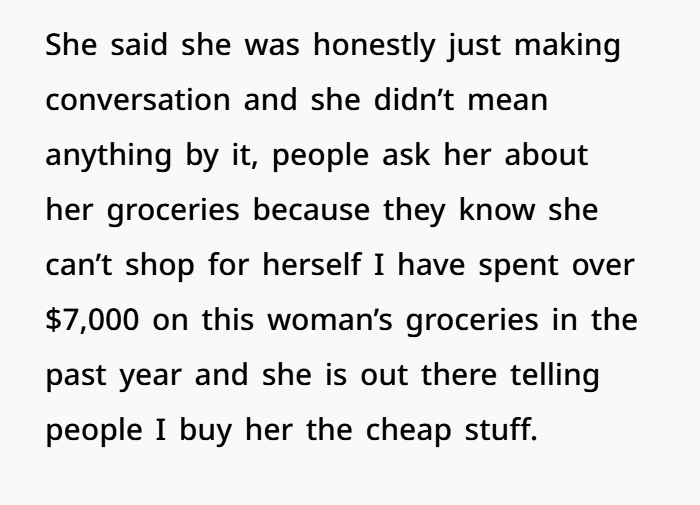
The woman was spending around $150 every week on groceries. Over the year, her total household expenses for helping her mother-in-law added up to more than $7,000. She never asked for money because her mother-in-law lived on a fixed income, and she and her husband could afford to help. Everything seemed fine until a recent family dinner at her sister-in-law’s house. One of her mother-in-law’s church friends thanked her for being so helpful but then mentioned something surprising. The friend said her mother-in-law had complained about getting store-brand groceries instead of more expensive products, including Boar’s Head deli meat. The woman felt embarrassed, especially because her mother-in-law was sitting there and did not say anything.
After dinner, the woman told her husband how upset she felt. She had spent a lot of time and money helping his mother, so hearing these comments was hurtful. However, her husband told her that his mother probably did not mean anything bad and suggested forgetting about it. The woman felt that he was not taking her feelings seriously. She later sent her mother-in-law a message asking about the comments. Her mother-in-law explained that she was only chatting with friends and did not mean to complain. But the woman still felt unappreciated after a year of paying for groceries and helping with senior care responsibilities.
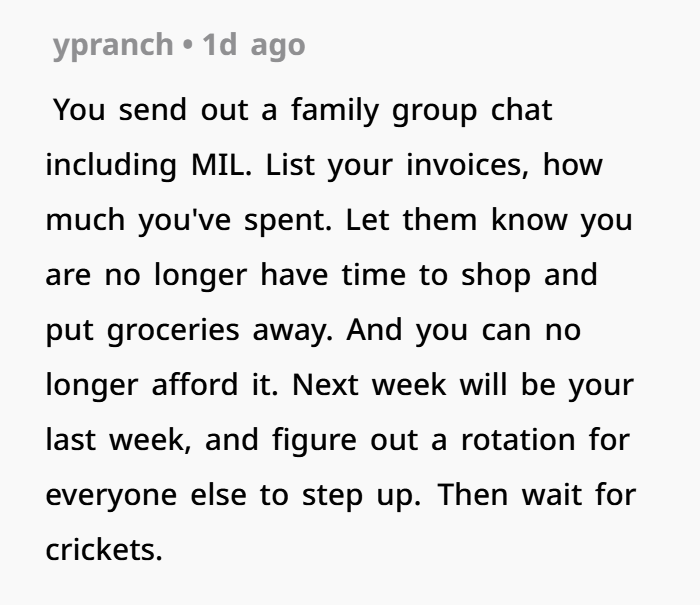
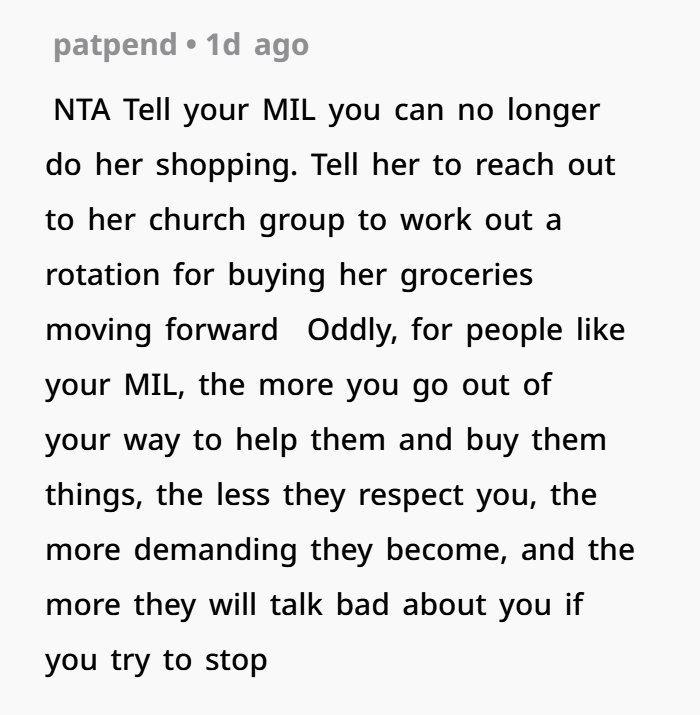
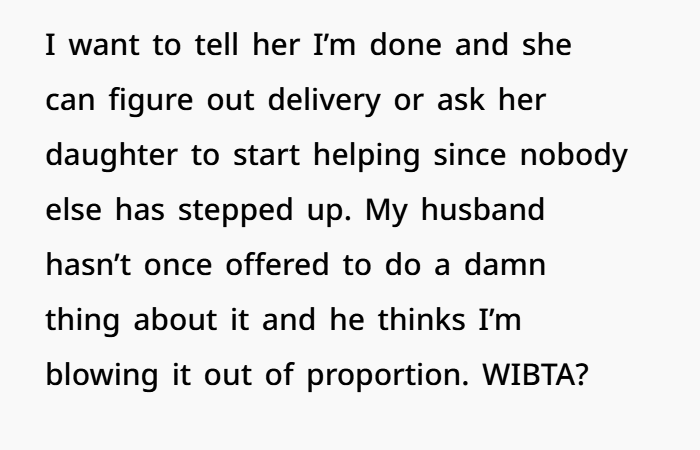
Now she is considering ending the weekly grocery trips completely. She believes her mother-in-law could use a grocery delivery service or ask her daughter for help instead. She also feels that her husband should take more responsibility if he wants the arrangement to continue. Although she understands that her mother-in-law has limited mobility and needs support, she does not want to keep spending her own money on something that seems unappreciated. The situation has raised questions about family budgeting, elderly care, and setting healthy boundaries with relatives. Is she wrong to stop helping after one hurtful comment, or does she have every right to step away from a favor that has become a costly responsibility?




Woman Stops Buying Groceries for Mother-in-Law After Hearing Complaints About Cheap Brands
A woman spent nearly a year buying groceries for her mother-in-law. She paid for the food herself, went shopping every week, and even put everything away after bringing it home.
She thought she was helping her family.
But then she heard something that made her question whether her kindness was being appreciated.
During a family gathering, someone mentioned that her mother-in-law had been complaining at church about the grocery brands she received.
The older woman apparently preferred more expensive products instead of the store-brand items her daughter-in-law bought.
That comment hurt.
The daughter-in-law had spent more than $7,000 helping her mother-in-law with groceries.
Now she was thinking about stopping the weekly shopping altogether.
But her husband told her not to make a big deal out of it.
The situation raises a difficult question: When you spend your own money helping a family member, is it wrong to stop when you feel unappreciated?
She Had Been Buying Groceries Every Week
The woman had been helping her mother-in-law with groceries for about a year.
Her mother-in-law was living on a fixed income and had health and mobility challenges following surgery.
Getting to the grocery store was not easy for her.
So the daughter-in-law stepped in.
Every week, she took time out of her day to shop for groceries.
She followed the shopping list, paid for the food, drove it to her mother-in-law’s home, and put everything away.
She did not ask to be paid back.
She wanted to make life easier for her husband’s mother.
Over time, the shopping became part of her weekly routine.
But it also became a regular expense.
She Spent More Than $7,000 on Groceries
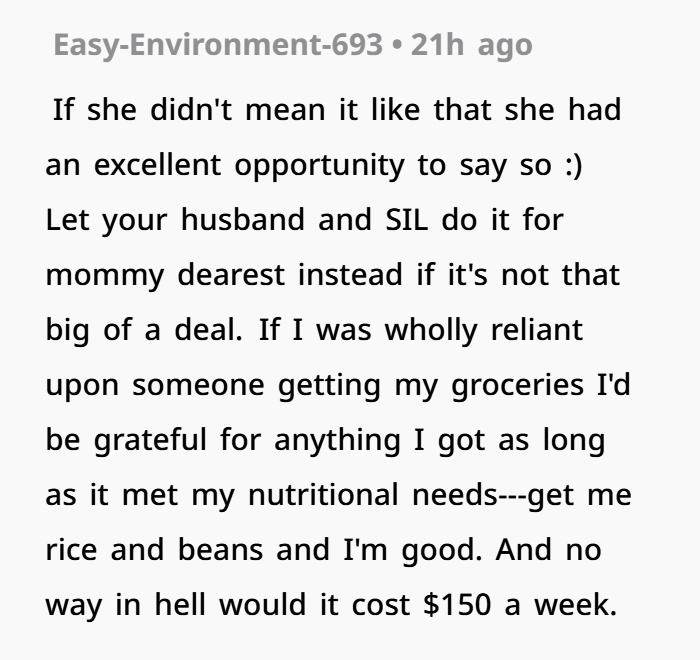
The woman estimated that she spent around $150 each week on groceries for her mother-in-law.
That may not sound like a huge amount for one shopping trip.
But weekly costs add up.
<box border radius=”lg” padding={3} gap={2}>
<text color=”secondary” weight=”medium” size=”xs”>Estimated grocery spending</text>
<grid columns={3} gap={2}>
<grid-item>
<text color=”secondary” size=”2xs”>Weekly</text>
<title size=”lg” color=”default” tabularNums>$150</title>
</grid-item>
<grid-item>
<text color=”secondary” size=”2xs”>Monthly average</text>
<title size=”lg” color=”default” tabularNums>$650</title>
</grid-item>
<grid-item>
<text color=”secondary” size=”2xs”>Yearly</text>
<title size=”lg” color=”default” tabularNums>$7,800</title>
</grid-item>
</grid>
<caption>Based on $150 per week for 52 weeks. Actual spending may vary. Transportation and personal time are not included.</caption>
</box>
The woman reported spending more than $7,000 over the year.
That is a meaningful amount of money.
For many households, it could cover several months of bills, help build emergency savings, or pay for important home expenses.
And the groceries were only part of her contribution.
She also spent time driving, shopping, and carrying everything into the house.
She was providing both financial help and practical support.
Why She Chose Store-Brand Groceries
When shopping for her mother-in-law, the woman sometimes bought store-brand products.
These are items sold under a grocery store’s own label.
Store-brand groceries are often less expensive than well-known national brands.
For example, a shopper might choose store-brand cereal, milk, snacks, or deli meat to keep the grocery bill manageable.
Many families use this approach to save money.
Choosing a lower-priced product does not automatically mean choosing something of poor quality.
The daughter-in-law was already paying for the groceries herself.
Buying affordable items helped her manage the cost of providing weekly support.
She was not refusing to buy food.
She was making sure her mother-in-law had groceries while keeping the spending reasonable.
But her mother-in-law apparently had different preferences.
Her Mother-in-Law Preferred More Expensive Brands
According to the story, the mother-in-law preferred certain premium grocery products.
One example involved deli meat.
She liked Boar’s Head products rather than less expensive store-brand alternatives.
There is nothing wrong with having a favorite brand.
People often prefer certain foods because of their taste, texture, or familiarity.
But premium products can cost more.
When someone else is paying the entire grocery bill, those preferences can become difficult.
The daughter-in-law was already spending around $150 each week.
Buying more expensive products could increase that amount.
She may have been willing to discuss specific preferences if her mother-in-law had asked her directly.
But that was not how she learned about the issue.
The Complaint Came Up at a Family Gathering
The woman found out about her mother-in-law’s dissatisfaction in an uncomfortable way.
During a family gathering, someone who knew her mother-in-law through church brought up the groceries.
The person mentioned that the older woman had been talking about receiving cheaper brands.
The daughter-in-law was surprised.
She had been buying the groceries for free.
She had never asked her mother-in-law to pay her back.
Now it sounded as though her effort was being criticized.
The comment was especially uncomfortable because other people were present.
She may have felt that her kindness was being questioned in front of family and guests.
Her mother-in-law did not explain the situation at that moment, according to the account.
That made the daughter-in-law feel even worse.
Why the Comment Hurt So Much
The woman was not simply upset about someone preferring a different brand of deli meat.
She was hurt because she had spent so much time and money helping.
For nearly a year, she had made sure her mother-in-law had food in the house.
She had paid thousands of dollars without expecting reimbursement.
Now she was hearing that the products were not good enough.
It made her wonder whether her help had become something everyone simply expected.
There is also an important detail to remember.
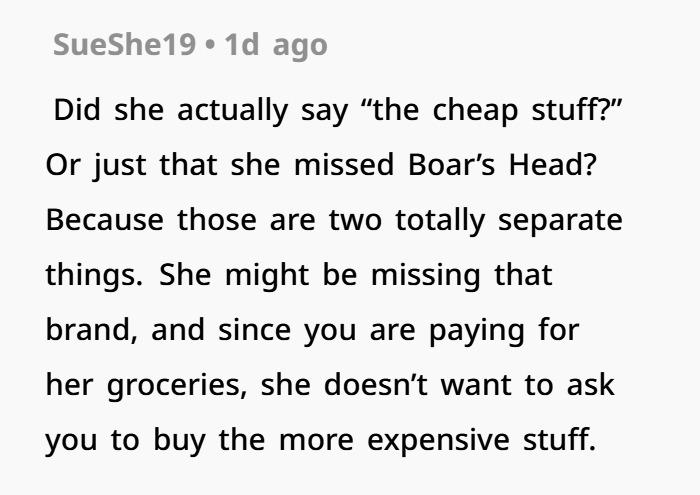
The story does not tell us exactly what the mother-in-law said at church.
She may have made a casual comment about missing a favorite brand.
The church friend may have repeated it in a way that sounded more negative.
So it would not be fair to assume that the mother-in-law was deliberately trying to embarrass her daughter-in-law.
Still, hearing the comment through someone else was understandably upsetting.
Helping an Older Family Member Can Be Expensive
Many families help older relatives with everyday tasks.
That support may include grocery shopping, cooking, transportation, cleaning, and paying household bills.
Some older adults live on retirement income or other fixed payments.
Rising grocery prices can make it harder to manage a monthly budget.
Health problems or limited mobility can also make shopping difficult.
That is why family assistance can be so valuable.
But helping an older relative takes time and money.
Even small weekly expenses can become a major part of a household budget.
Families may need to discuss who will pay for groceries, who will do the shopping, and how long the arrangement will continue.
Without a clear plan, one person can end up handling everything.
That appears to be what happened here.
Her Husband Did Not Think It Was a Big Deal
After hearing the comment, the woman talked to her husband.
She explained why she felt hurt.
But according to her account, he did not seem concerned.
He suggested that his mother probably did not mean anything negative.
He encouraged his wife to let it go.
That response made the situation more frustrating.
The woman had been paying for his mother’s groceries and doing the shopping.
Yet he did not appear to recognize how much work she had been doing.
The woman also said that her husband often responded this way when disagreements involved his mother.
That suggests the grocery problem may not be the only source of frustration.
She may feel that her efforts are overlooked whenever a family issue comes up.
Why the Husband’s Role Matters
The mother-in-law is the husband’s mother.
But his wife has been handling the grocery shopping.
She has been paying for the food and making the weekly trips.
According to the story, the husband and his sister have not been sharing much of that responsibility.
That raises another question.
Why should one person be expected to handle all the shopping and costs?
The husband may not have realized how much the arrangement had grown over time.
But now that his wife is unhappy, he has an opportunity to help.
He could start doing the shopping himself.
He could contribute money toward the groceries.
He could also work with his sister to create a better family plan.
Even if he believes his mother did not mean to complain, he can still recognize his wife’s contribution.
The two issues are separate.
He can defend his mother’s intentions while also appreciating what his wife has done.
Is It Wrong to Stop Paying for the Groceries?
The daughter-in-law is now thinking about ending the weekly grocery arrangement.
That does not automatically make her unreasonable.
She began helping because she wanted to.
There is no indication that she promised to pay for her mother-in-law’s groceries forever.
Spending thousands of dollars each year is a major commitment.
She is allowed to review her household budget and decide what she can continue to afford.
She is also allowed to consider how much time the shopping takes.
But there is another concern.
Her mother-in-law may still need help getting food.
Stopping without warning could create a difficult situation, especially if the older woman has limited mobility.
A more thoughtful approach would be to give the family time to make another plan.
The daughter-in-law could set a date when she will stop paying or shopping.
That would allow her to establish a financial boundary without leaving her mother-in-law without grocery access.
Could the Family Share the Grocery Costs?
There are several ways the family could make the arrangement more balanced.
The husband could begin paying for his mother’s groceries.
His sister could contribute part of the weekly cost.
They could take turns shopping or arranging deliveries.
The mother-in-law might also be able to pay for some items from her own budget.
If she prefers premium deli meat or other higher-priced products, she could offer to cover the extra cost.
That would allow her to enjoy her favorite foods without expecting one person to pay for everything.
Another option would be to create a weekly grocery budget.
The family could agree on a spending limit and make a shopping list that fits within it.
This would help everyone understand what is affordable.
The goal should be to find a plan that meets the mother-in-law’s needs without placing all the responsibility on one person.
Could Grocery Delivery Make Things Easier?
If shopping is difficult because of mobility problems, grocery delivery may be worth considering.
Many supermarkets offer online grocery ordering.
Customers can choose products, compare prices, and arrange delivery or pickup.
Some services charge delivery fees or require a membership.
The total cost depends on the store and location.
For families managing an older relative’s groceries, delivery can reduce the need for weekly shopping trips.
The husband or sister-in-law could place the order online.
They could also help create a shopping list and check the total before paying.
This would not automatically solve the financial issue.
But it could reduce the amount of time the daughter-in-law spends shopping and driving.
For older adults who need additional support, local senior assistance programs may also provide information about meal delivery or transportation.
Why Financial Boundaries Matter in Families
Helping family can be a wonderful thing.
But it becomes difficult when a voluntary favor starts to feel like a permanent responsibility.
A person may begin by helping for a few weeks.
Then a few weeks become several months.
Before long, everyone expects the help to continue.
The person providing support may feel uncomfortable saying no.
They may worry about disappointing relatives or creating family tension.
But setting a boundary does not mean someone has stopped caring.
It simply means they are being clear about what they can offer.
In this case, the daughter-in-law has already provided a great deal of support.
She can appreciate her mother-in-law and still decide that she no longer wants to pay for weekly groceries.
Both feelings can exist at the same time.
Should the Mother-in-Law Be Allowed to Have Preferences?
The mother-in-law is allowed to prefer certain foods.
Receiving help does not mean someone must stop having opinions.
She may genuinely enjoy premium deli meat more than a store-brand version.
But preferences are easier to discuss when everyone understands the budget.
If she wants a more expensive item, she could ask politely.
She could also offer to pay the difference.
That would be different from making comments that leave the person paying for the food feeling criticized.
The daughter-in-law may have been more understanding if the request had come directly from her mother-in-law.
Instead, she heard about it from someone else.
That made a simple grocery preference feel like a personal complaint.
What Would Be the Fairest Solution?
The daughter-in-law does not need to continue the same arrangement forever.
She has already spent more than $7,000 helping her mother-in-law.
That is a significant contribution.
But ending the arrangement does not have to become a family argument.
She could explain that she is no longer able or willing to cover the weekly grocery costs.
She could give her husband and sister-in-law time to arrange another solution.
The family could then decide who will pay, shop, or manage grocery delivery.
It may also help for the daughter-in-law to speak privately with her mother-in-law.
She could explain that she heard the comment about the grocery brands and felt hurt.
That would give the older woman a chance to explain what she meant.
There may have been a misunderstanding.
Or the mother-in-law may not have realized how much her daughter-in-law was spending.
Either way, a direct conversation would be better than allowing resentment to grow.
When Family Help Starts Feeling Taken for Granted
One of the hardest parts of helping family is knowing when to stop.
At first, people may be very thankful.
But when help becomes part of their normal routine, they may stop noticing the effort involved.
The weekly groceries simply appear.
Someone pays for them.
Someone carries them inside.
Someone puts them away.
Over time, the work can become almost invisible.
That may be why the church comment hurt the daughter-in-law so much.
She was not expecting praise every week.
But she probably did not expect to hear complaints about the brands she was buying.
Her reaction suggests that she wants her time, money, and effort to be recognized.
That is a reasonable thing to want.
Final Thoughts: Should She Keep Buying the Groceries?
The daughter-in-law has spent nearly a year buying groceries for her mother-in-law.
She has paid more than $7,000 and handled the weekly shopping herself.
Her mother-in-law has benefited from that help, especially while dealing with limited income and mobility problems.
But the daughter-in-law now feels unappreciated after hearing that her mother-in-law may have complained about receiving cheaper brands.
Her husband’s response has made the situation even more frustrating.
Based on the details shared, she has a reasonable reason to reconsider the arrangement.
She does not have to keep paying for groceries simply because she has done so in the past.
However, giving the family time to arrange another way to provide food would be a thoughtful approach.
Helping family should come from kindness, not from the feeling that you have no choice.
What would you do? If you spent more than $7,000 buying groceries for a relative and then heard complaints about the brands, would you keep helping or ask the rest of the family to take over?
The Most Honest Comments