
AIBU for being angry that my ex hid his cancer diagnosis from me?
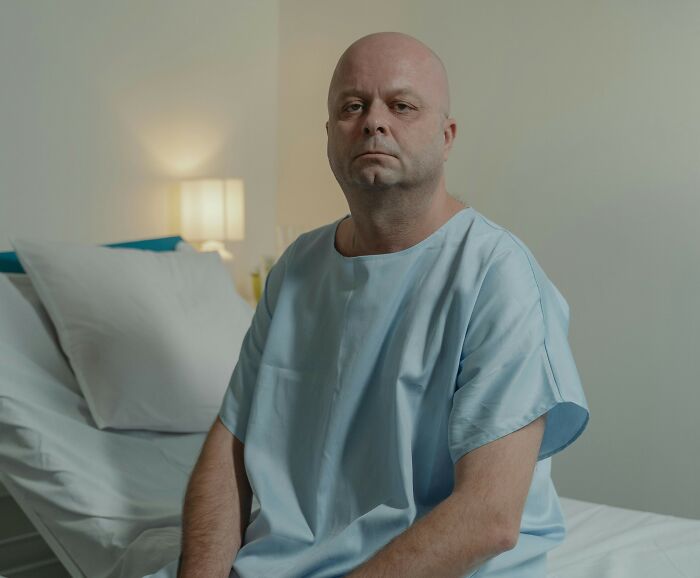
OP was with her ex for over 25 years, separated for the last 2.5, but they’ve remained unusually close — still seeing each other almost daily, co-parenting two teenagers, and relying on each other in ways that go beyond a typical “ex” relationship. Recently, though, OP discovered something huge: her ex has stage 3 prostate cancer, diagnosed at the end of July, and he’s already undergone multiple rounds of radiotherapy.
The discovery wasn’t through honest conversation — OP stumbled upon it accidentally while snooping through his post at his flat. When she confronted him, he admitted it but was strangely casual, saying it’s “nobody’s business.” He hasn’t told his family either — not his mother, not his siblings. Just one work contact so he could cover shifts. OP feels hurt, betrayed, and angry. This is a man who, when they were together, was a notorious hypochondriac. Now, when the threat is real, he’s gone completely the other way.
She still cares deeply for him, admits he means the world to her, and feels gutted that he doesn’t want her support. Her questions are simple but heavy: is she wrong to think he should have told her, and that he should keep her updated — especially since they share two teenage kids?
When someone close to us faces a serious illness, the instinct is often to want to know everything

After separating two and a half years ago, the author and her ex-husband have remained close while co-parenting their two teenage children
Alright, let’s sit with this one for a second. Your ex has stage 3 prostate cancer, a pretty serious diagnosis, and he didn’t tell you, his mum, his siblings, or even his kids. Just one coworker because he literally had to cover shifts. You only found out by snooping mail at his flat. Now you’re left sitting with this big ball of anger, confusion, and sadness, asking yourself: is he wrong for keeping it private, or are you wrong for expecting to be included?
This is where things get messy — because it’s not just about medical privacy, it’s about your shared history, your co-parenting responsibilities, and the fact that you still care for him. Let’s unpack this step by step.
1. The right to medical privacy
First, the blunt truth: legally speaking, he doesn’t owe anyone — not even you, not even his mum — disclosure about his health. Under privacy laws like HIPAA in the U.S. or GDPR in Europe, individuals have an absolute right to keep their health information private. Even family members can be left completely in the dark unless the patient decides otherwise.
Doctors, hospitals, and clinics can’t share anything without patient consent. Even if you showed up and said “I’m his ex and co-parent of his kids,” the medical staff would legally have to shut you down unless he signed a release form. This is important, because sometimes when we feel entitled to information, it clashes hard against legal rights.
But — just because he’s allowed to keep it private doesn’t mean it doesn’t sting like hell when he does.
2. Why people hide a cancer diagnosis
This is where psychology comes in. Researchers have found a bunch of reasons why patients sometimes keep illnesses to themselves:
- Denial & control: Admitting it out loud makes it real. Keeping it private gives them a sense of control.
- Fear of pity: Some people don’t want to be seen as “the sick one.” They don’t want sad eyes every time they walk into a room.
- Protecting loved ones: Ironically, by not telling, they think they’re sparing others from worry or grief.
- Personality flips: You said he used to be a hypochondriac. Sometimes, when people face a real diagnosis, they overcorrect — almost stubbornly refusing to act sick.
So his casual “who cares, it’s no one’s business” might actually be him shielding himself. It may not be about not trusting you. It could be him trying to survive emotionally.
3. But what about the kids?
This is where I think you have the strongest point. Co-parenting isn’t just about holidays, schedules, and pick-ups — it’s about shared responsibility for the emotional and practical wellbeing of your children.
Two teenagers deserve honesty, especially when something major like a parent’s cancer could affect their stability. Not telling them now might mean they find out later in a way that feels like betrayal. Imagine if treatment fails, or if they notice his energy dropping, or if they overhear something. The emotional damage from secrecy can be worse than the illness itself.

Family counselors usually recommend that parents be upfront (age-appropriately) about health issues. Research shows that children cope better with serious illness in the family when they’re included early, rather than shielded until crisis hits. Kids pick up on more than we give them credit for. Hiding things often backfires.
4. Your anger — justified or selfish?
Let’s talk about your anger. Some people might say: “It’s his body, his choice, get over it.” And sure, on paper that’s true. But you’re not just some random ex. You’re someone who spent 25 years with him. You’re someone who still co-parents daily. You’re someone who clearly still loves him, even if you’re not together.
So the anger isn’t just about the diagnosis being hidden. It’s about feeling shut out from a life-altering moment. It’s about being treated like an outsider when your connection says you’re still on the inside. And it’s about the sheer whiplash — he was once a guy who obsessed over every sneeze, and now he’s brushing off cancer like it’s a cold. Of course that feels maddening.
The selfish piece? Maybe a little. Part of your anger might be less about him and more about what it means for you. You didn’t get to process this news on your own terms. You didn’t get the trust or intimacy of being told directly. You found out by accident, and now you’re dealing with betrayal as well as grief. That’s a heavy cocktail.
5. Examples from others
There are plenty of stories out there where people hid illnesses:
- A man in his 40s hid his colon cancer until it reached stage 4 because he didn’t want to “burden” his wife. When she found out, she was furious — not at the cancer, but at being excluded from the journey. Their marriage never fully recovered.
- A mother kept her breast cancer secret from her adult kids until chemo started showing physical signs. The kids later described it as “a second betrayal — first the disease, then the secrecy.”
- On the flip side, some people report being relieved when loved ones didn’t tell them until later. One woman said her dad’s silence about prostate cancer gave her “two extra months of normalcy” before worry consumed her.
So there isn’t one right answer here. Different people value different balances of privacy and inclusion.
6. What now?
You can’t change the fact that he kept it secret. But you can decide how you move forward:

- Communicate boundaries: Tell him you respect his privacy but expect to be kept in the loop about things that directly affect your kids. That’s not about ex-rights, that’s about parental duty.
- Support, but don’t smother: Instead of demanding updates, offer practical help: drives to appointments, meals, kid coverage. If he says no, step back.
- Talk to the kids: If he continues hiding, you may eventually need to push harder for honesty with the children. A family therapist could help.
- Process your own grief: Anger is often grief in disguise. You’re grieving the man you thought you knew — the one who would never shut you out. Give yourself space to mourn that shift.
7. So, is he wrong?
- For not telling you personally? Morally, probably yes. After 25 years together and as co-parent, you should have been trusted with the truth.
- For keeping it from his mum and siblings? That’s his call. Families have different dynamics.
- For not telling the kids? That’s the one place where his right to privacy clashes with his duty as a dad. Kids deserve honesty.
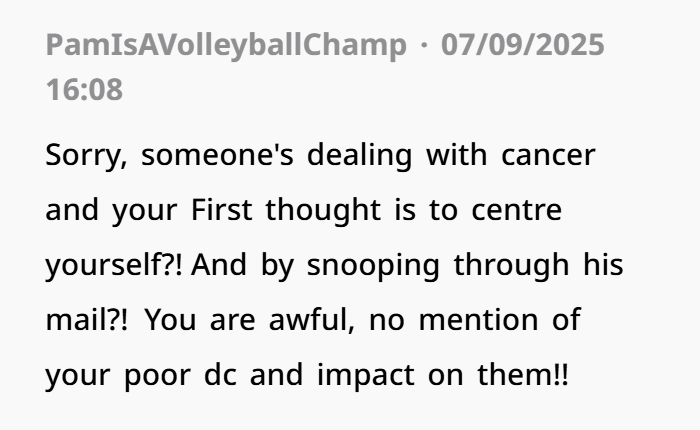
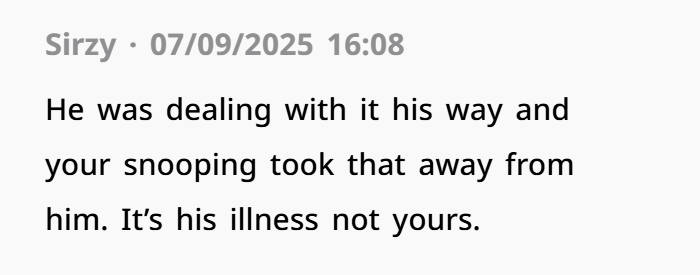
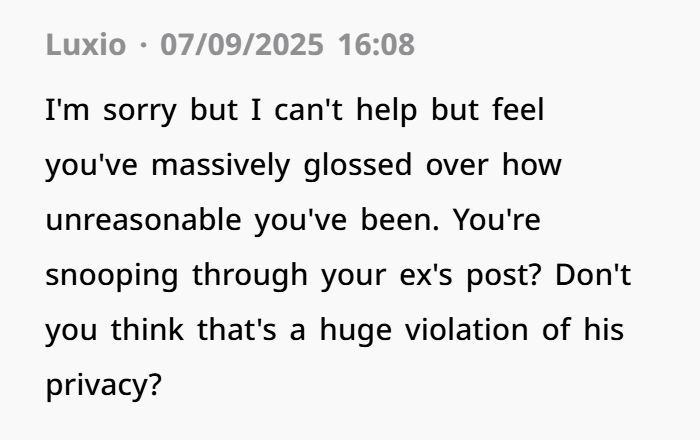
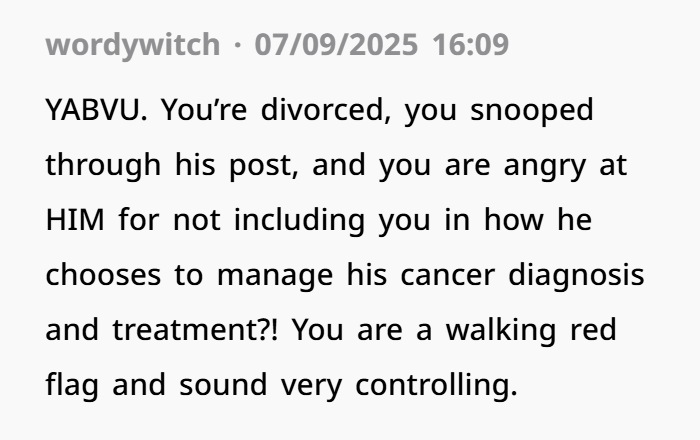
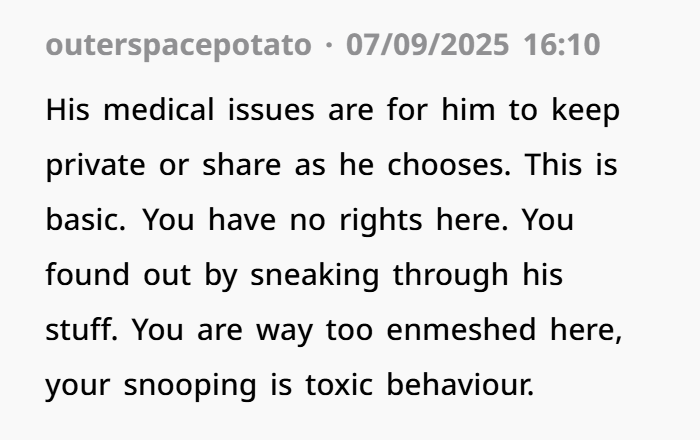
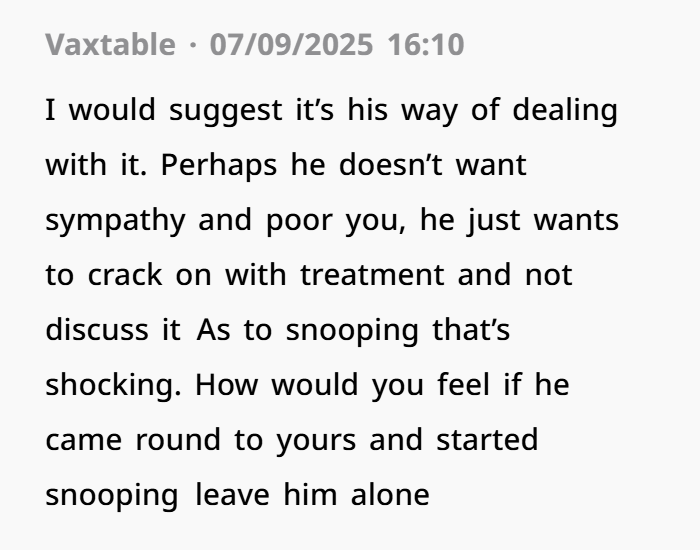
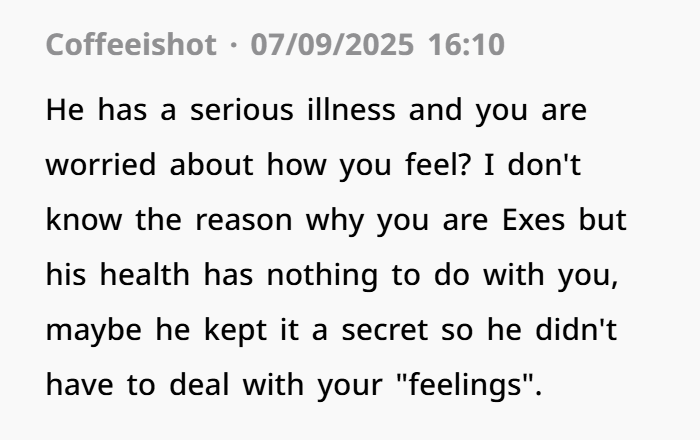
Netizens criticized her for snooping through his mail and criticized her even more for being self-centered in this situation
So, AIBU to be angry? Nope. Anger is natural here. You’re not being dramatic, you’re not being needy. You’re responding to a painful mix of shock, betrayal, and love. But the key now is not letting the anger consume the relationship — because whether you’re his partner or not, you’re still in this story, and so are your kids.
Sometimes love doesn’t end just because the romance did. And sometimes, even when we don’t get invited into someone’s fight, we show up anyway — not to demand, not to control, but simply to be there.