
What Are Solid-State Batteries and Why Are They Important for Electric Vehicles?
Every electric vehicle on the road today carries a lithium-ion battery, and most drivers know its limits. Charging takes longer than filling a tank, range drops in cold weather, and a damaged pack can catch fire. These are the reasons many buyers still hesitate before switching to an electric car.
Solid-state batteries promise to change that picture. They replace the liquid electrolyte inside today’s batteries with a solid material, opening the door to longer range, faster charging, and safer packs. By 2025, the technology has moved from the lab bench to test vehicles on real roads.
This article explains what solid-state batteries are, how they differ from the lithium-ion packs in today’s EVs, where the technology stands in 2025, and what still needs to happen before you can buy a car that uses one.

What Solid-State Batteries Are
A solid-state battery is a rechargeable battery that uses a solid electrolyte instead of a liquid one. In a normal lithium-ion battery, lithium ions travel back and forth between the two electrodes through a liquid electrolyte, usually a flammable organic solvent. In a solid-state battery, that liquid is replaced by a solid material such as a ceramic, a sulfide compound, or a specially designed polymer. The ions still move between the electrodes, but through a solid layer.
That change matters more than it sounds. A solid electrolyte is not flammable in the way a liquid one is, so the risk of a battery fire drops. A solid layer can also be thinner than the separator and liquid layer it replaces, which leaves more room for the materials that store energy. And it can work with a lithium-metal anode, a pure lithium electrode that stores more energy in the same space than the graphite anode in most lithium-ion cells today.
There is no single solid-state design. Researchers use several types of solid electrolyte, each with trade-offs. Sulfide electrolytes conduct ions well but can be sensitive to moisture. Oxide electrolytes, often ceramic, are stable but brittle and hard to shape into thin layers. Polymer electrolytes are flexible and easy to process but conduct ions more slowly. Most companies have picked one path and are working to solve its specific problems.
How They Differ From Lithium-Ion Batteries
The easiest way to understand solid-state batteries is to compare them with the lithium-ion batteries in today’s electric cars. The two share the same job, storing energy and releasing it on demand, but they are built differently, and those differences show up in range, charging, and safety.
| Feature | Lithium-ion battery | Solid-state battery |
|---|---|---|
| Electrolyte | Liquid, flammable solvent | Solid ceramic, sulfide, or polymer |
| Anode | Usually graphite | Often lithium metal |
| Energy density | Lower, limited by graphite | Higher potential |
| Charging speed | Limited by heat and lithium plating | Faster potential |
| Fire risk | Higher, liquid electrolyte can burn | Lower, solid electrolyte resists burning |
| Operating temperature | Weak in extreme cold | Wider range in most designs |
| Maturity | Mass-produced for decades | Pilot lines and test vehicles |
The table makes the advantage look simple, but a lithium-ion battery is a mature product, made by the millions in factories refined over decades. A solid-state battery is still new, and its advantages only count once it can be made at the same scale and cost, with a similar working life.
Why Solid-State Batteries Matter for Electric Vehicles
Range is the first reason solid-state batteries matter. Because a lithium-metal battery can store more energy in the same volume, a car with a solid-state pack could travel further on a single charge than the same car with a lithium-ion pack. That matters most for buyers who worry about long trips, drivers in rural areas with few chargers, and larger vehicles such as trucks.
Charging speed is the second reason. A solid-state cell can accept a higher charging rate without the same risk of lithium plating, the process where lithium builds up on the anode surface during fast charging and damages the cell. In practice, that could mean shorter stops at fast chargers, which is the difference between a quick top-up and a long wait. Carmakers have talked about charging times measured in minutes rather than hours, though those figures depend on the charger too.
Safety is the third reason, and it may matter most for public trust. Liquid electrolytes can catch fire if a battery is damaged or overheats, and EV fires, though rare, attract a great deal of attention. A solid electrolyte removes the most flammable part of the battery. That does not make a solid-state pack impossible to damage, but it makes a serious fire far less likely, which matters for insurance, for enclosed parking garages, and for drivers who simply want to feel safe.
A fourth benefit is weight and packaging. A more energy-dense battery can be smaller and lighter for the same range, freeing up space inside the car and improving handling. A lighter car also needs less energy to move, so the gains feed back into range.
The benefits reach beyond passenger cars. Delivery robots and other electric machines that work all day need batteries that charge fast and last long, and our article on autonomous delivery robots looks at how those vehicles are changing last-mile logistics. A better battery would make them more practical still.
Where the Technology Stands in 2025
By September 2025, solid-state batteries have left the pure research stage, but they have not yet reached mass production. What exists is a busy middle ground of pilot production lines, test fleets, and supply agreements between carmakers and battery specialists.
Toyota is the most visible player. It has said it aims to start production in 2027 to 2028, working with the Japanese energy company Idemitsu Kosan on sulfide-based solid electrolyte material. Toyota has shown prototype vehicles with solid-state packs and plans to introduce the technology in a limited model first.
QuantumScape, a US battery developer backed by Volkswagen, uses a ceramic separator with a lithium-metal anode and no graphite. It has shipped test cells to carmakers and, in 2024, agreed with Volkswagen’s battery unit PowerCo to industrialise the technology. In 2025, its work is focused on scaling up production of its QSE-5 cell and proving it can be made reliably at larger scale.

Samsung SDI has built a pilot line for solid-state batteries in South Korea and is targeting mass production in 2027. Solid Power, a US company working with BMW and Ford, is developing sulfide-based cells and supplying test cells to its partners. Factorial Energy, which works with Mercedes-Benz, Stellantis, and Hyundai-Kia, reached a visible milestone in early 2025, when Mercedes-Benz began road testing a prototype EQS fitted with its solid-state cells.
Honda has built a pilot production line in Japan, aiming to bring the technology to its cars late in the decade. Nissan has said it aims to launch an EV with a solid-state battery in 2028. In China, CATL, the world’s largest battery maker, has worked on condensed-matter and semi-solid-state designs, and Chinese carmakers have shown concept vehicles with solid-state packs.
That is a lot of activity, but none of it means a solid-state EV is on sale yet. The companies describe their work as preparation: building pilot lines, testing cells in vehicles, and learning how to make them at scale. The timeline most of them point to is the late 2020s, not 2025.
The Problems Still to Solve
The biggest technical problem is the interface between the solid electrolyte and the electrodes. In a liquid battery, the liquid flows into every gap and keeps good contact with the electrode surfaces. A solid layer cannot do that as easily, so gaps form and resistance rises. Over many charge cycles, the electrodes expand and contract, which can crack the solid layer or pull it away from the surface.
Dendrites are a second problem. These thin, needle-like growths of lithium metal can form on the anode during charging, and in a liquid battery they can pierce the separator and cause a short circuit. A solid electrolyte was once expected to block dendrites completely, but lithium can still push through cracks and weak spots in the solid layer. Preventing dendrites while keeping the cell thin and light remains an active area of research.
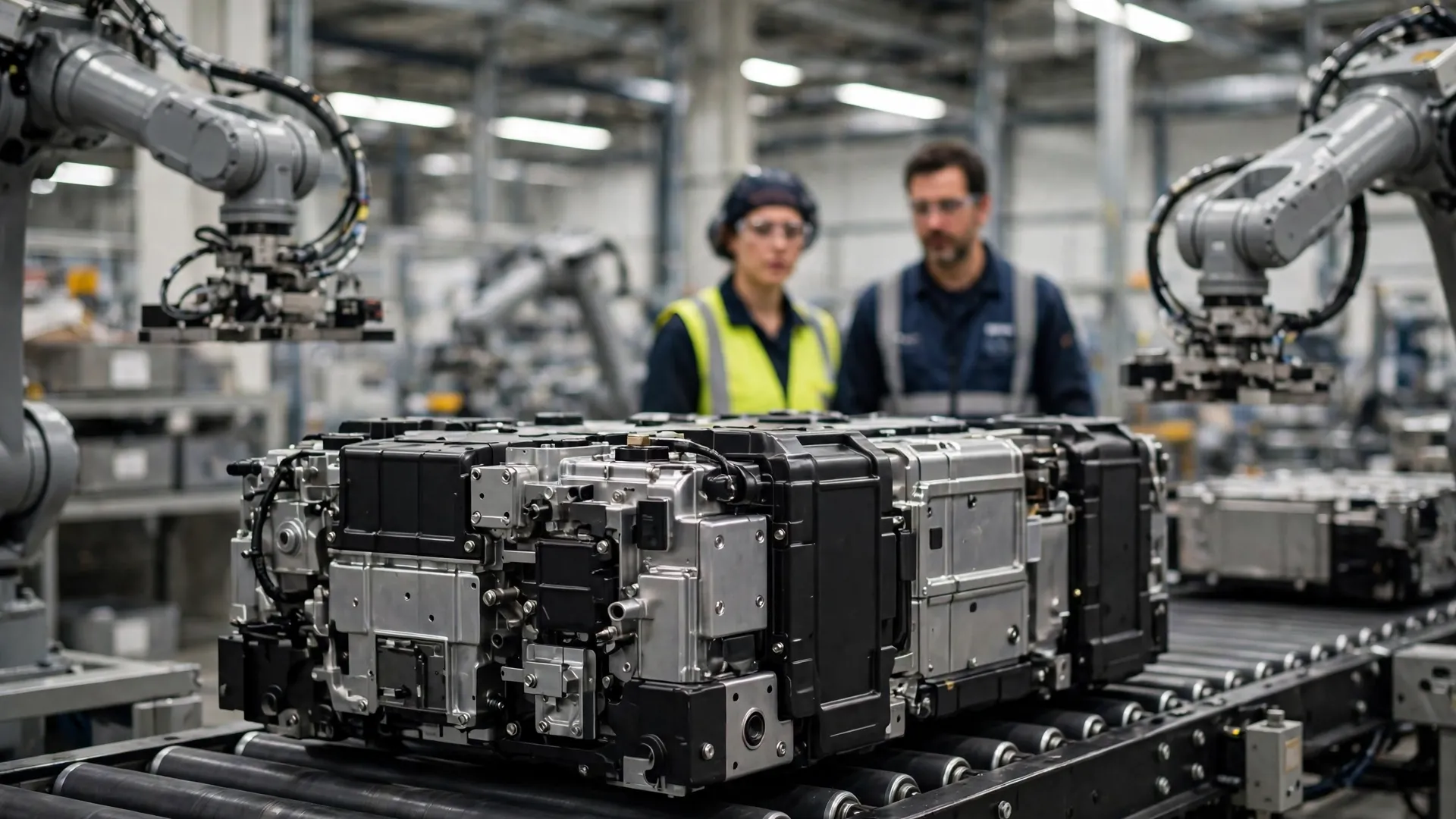
Manufacturing is the third problem, and it may be the hardest. Making solid-state cells requires new factories, new processes, and tight control over moisture and contamination, especially for sulfide electrolytes. A lithium-ion factory cannot simply be converted. Each company is building pilot lines to learn how to make cells consistently, and the yield, the share of cells that pass quality checks, is closely watched. These new factories will also lean heavily on automation and robotics, the kind of physical AI now moving from labs into industrial work, to keep production precise and repeatable.
Cost is the fourth problem. The materials and processes for solid-state cells are more expensive today than those for lithium-ion cells, and that gap will only close with volume. Until factories run at scale, a solid-state pack will cost more, and carmakers will have to decide whether buyers will pay for the extra range and faster charging.
Finally, there is cycle life. A car battery needs to survive many hundreds of full charge cycles while keeping most of its capacity. Some solid-state designs have shown good results in the lab, but proving that performance holds up over years of real driving, in hot and cold weather, is still under way.
New materials could help close these gaps. Our article on AI designing new materials explains how machine learning is speeding up the search for better battery materials, including solid electrolytes that conduct ions faster and resist dendrites. Better materials found that way could shorten the road to a production-ready cell.

Practical Tips / Examples / Things to Know
- If you are buying an EV in 2025, choose on today’s lithium-ion technology, not on the promise of solid-state batteries, since no mass-market solid-state car is on sale yet.
- Check the battery warranty and the charging network before you buy, because those matter more in daily use than the chemistry inside the pack.
- If you hear a claim about a solid-state car arriving soon, check whether the source means a prototype, a pilot line, or a car you can actually buy.
- Keep an eye on the factories building solid-state packs, not only on the research, since manufacturing scale is what will bring prices down.
Common Mistakes / Considerations / What to Avoid
- Assuming solid-state batteries are already in cars you can buy, when in 2025 they are still in test vehicles and pilot production.
- Expecting every solid-state battery to double your range, when the real gains depend on the cell design, the car, and the driving conditions.
- Believing a solid-state battery can never catch fire, when it is safer than a lithium-ion pack but not immune to damage or failure.
- Waiting years to buy an EV in the hope of a solid-state model, when today’s lithium-ion cars already cover most driving needs.
Final Thoughts
Solid-state batteries are the most important battery idea in electric vehicles today, and the reason is simple: they attack the three things drivers complain about most, range, charging time, and safety, all at once. The technology has real momentum in 2025, with Toyota, Samsung SDI, QuantumScape, Factorial Energy, and others running pilot lines and testing cells in real cars.
Yet the honest picture is that the hard work is still ahead. The interfaces need to last, dendrites need to be controlled, factories need to be built, and costs need to come down. The late 2020s are the realistic window, not next year. For anyone buying an EV now, the right move is to judge today’s cars on their own merits and treat solid-state batteries as the next step, not a reason to wait.